
What should stepkids call a stepparent?
A stepparent name is whatever a child actually uses for their parent’s spouse, and the honest answer to what should stepkids call a stepparent is that no correct one exists: the choice belongs to the child more than to the adults arranging the household. Most families end up at the stepparent’s first name, a shortened version of it, or something the child made up and nobody planned.
The names that last are the ones nobody had to enforce. A name that has to be corrected into place — at the table, in front of relatives, on the phone with the other household — is usually carrying a job it cannot do: proving that the new family is real.
The names families actually use
Six patterns come up repeatedly in how stepfamilies describe this. Stepfamilies are households in which at least one adult is living with a partner’s child from an earlier relationship, and the range below is what they report rather than a ranking. None of it is recommended here; the patterns are listed so a household can see the trade-offs before it drifts into one by accident.
| What the child says | Where it usually comes from | What it tends to signal | Where it gets awkward |
|---|---|---|---|
| First name | The default when nobody decides anything | Neutral; no claim on the parent role | Can read as distant to relatives who expected more |
| Nickname or shortened name | Invented by the child, often when young | Affection without a title | Hard to explain to teachers and doctors |
| Mum / Dad | Usually child-initiated, often after years | Full parent language | Can land badly with the other parent, and can be withdrawn later |
| A parent-word from another language | Papa, Mama, Baba, Tata and similar | Parent warmth without taking the other parent’s word | Needs a family reason, or it reads as a workaround |
| Title plus first name | Older children, or a formal household | Respect at a distance | Rarely survives into the teenage years |
| No name at all | The child avoids addressing the stepparent directly | Unresolved, not necessarily hostile | Invisible until someone notices it has gone on for months |
The last row is the one people miss. A child who says “hey” or waits until eye contact rather than using any name has made a choice, and it is often the most informative one in the house.
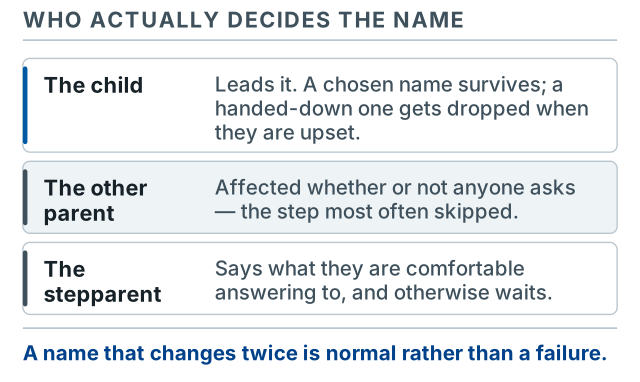
Who decides — the child, the parent, or the stepparent?
In practice the child decides, the biological parent sets the tone, and the stepparent gets a veto on nothing except how they are introduced by adults. That order is uncomfortable for the person whose name is under discussion, and it is still the order most households end up operating.
What the couple can decide in advance is narrower, and covers only things such as what the stepparent will be called when adults introduce them, whether any name is off-limits, and what happens if the child tries out something the other household will hear about. Those are conversations between the adults, and they go better before the wedding than after.
What if a stepchild starts calling you Mum or Dad?
Families describe this as the moment with the most weight and the least warning — often at school, in front of another adult, or mid-sentence at home. They describe reacting visibly, in either direction, as the part they later thought about most.
There is also the other household to consider. A parent word is any of the terms already in use for a legal or biological parent — Mum, Dad, and their equivalents in other languages — and it carries weight precisely because it is in use elsewhere. A parent who hears secondhand that their child now uses theirs for someone else usually reacts to the fact that they heard it secondhand. Where relations allow it, the information travels better from the household it started in than from the child.
And it can be temporary. Children try names the way they try other things, and a term dropped after a few months is not necessarily a verdict on anyone.
Does the name change as children get older?
Sometimes, and households describe the change happening quietly. A word invented in early childhood can fall out of use as the child grows, without anyone announcing it — the child simply stops using the old one and does not replace it for a while.
Adult stepchildren present a different version of the question. Someone who acquires a stepparent in their thirties generally has no childhood name to fall back on and no reason to use a parent word, and the first name is the usual landing point. The friction there is seldom about the name and more often about property and paperwork, which is a separate subject and belongs with the money and paperwork side of the site.
What do you call them — “my stepson” or “my son”?
This half of the question gets less attention and causes at least as much trouble. A term of reference is what an adult calls the child when speaking about them to someone else, as distinct from what the child calls the adult, and it is a choice made in front of the child. For instance, a form at a medical practice and a remark at the school gate are not the same setting, and households often use different words in each.
Households describe three habits: using “step” consistently everywhere, dropping it in casual conversation and keeping it where accuracy matters, or asking the child what they would prefer to be called in front of other people. The third is the only one that involves the child, and it also requires being willing to hear an answer nobody wanted.
Two places where precision matters regardless of the household habit: medical and school settings, where staff act on stated relationships, and any document where the relationship has consequences. What a child calls a stepparent at home changes nothing about standing anywhere official. That distinction sits alongside the rest of the practical groundwork in the stepparenting hub.
What the adults settle before the question comes up
Naming is the visible surface of arrangements the adults have usually not finished making. The questions below are the ones households report wishing they had settled first, with the person who can actually answer each one.
What this page will not tell you
The category is full of confident answers about other people's children. Here is what is deliberately missing.
- A recommended name
- Every option in the table works in some households and fails in others. Ranking them would mean ranking families we have never met.
- A timeline
- Guides that state how long a stepchild takes to settle on a name are quoting folklore. There is no verified figure, and this site does not print numbers it cannot source.
- A reading of your stepchild
- What a child’s choice of name means about the child is not something a web page can determine. That question goes to someone who can meet the family.
- Scripts for managing the other parent
- Wording designed to steer an ex-partner is manipulation with better grammar. What is here instead is what to tell them and when.
What if there is no name and the silence is getting long?
A child who has avoided using any name for months is telling the household something, and the useful response is usually to stop asking. Families describe pressure at this stage as the thing most likely to fix the silence in place.
What can be removed is the requirement. Nothing in daily life actually needs the child to use a name — meals, lifts, homework and holidays all run without one — and households report that the question tends to resolve itself once it stops being asked at the table. How a household handles the wider version of this sits with the rest of the blended family material.
Where this page stops
This page describes patterns families report. It does not assess a particular child, and it cannot tell anyone what a specific silence, name or refusal means in their house.
When the naming question keeps producing conflict — between the couple, between households, or with a child who is visibly struggling — the next step is a family therapist or, where two households cannot agree, a mediator. If anyone in the household is in crisis, contact a helpline in your country or local emergency services rather than working from an article.