A stepfamily is a household in which at least one adult is raising a child who is not theirs by birth or adoption, formed when a parent partners or marries again. A blended family means the same household described from the other direction — two families that already existed, merged into one address. The words are interchangeable in ordinary use, and this section treats them as one thing rather than pretending a distinction that nobody applies consistently.
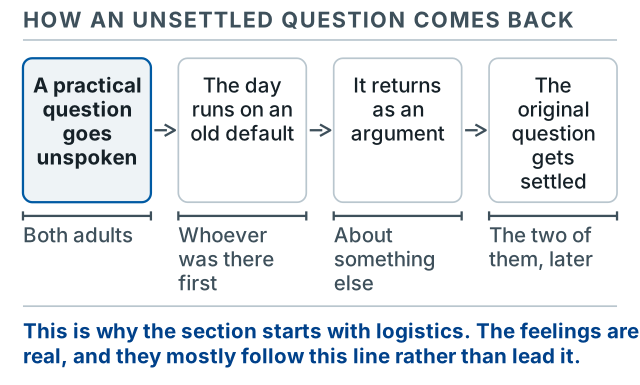
What the section is actually about is the logistics. Whose house, whose rules, whose weekend, whose money, and who is allowed to answer when a child asks. The emotional part is real and it is mostly downstream: households that never settled the practical questions report meeting them again as arguments about something else.
What actually changes when two households become one?
Everything that used to be decided by one adult alone is now decided by two, and not always the two with the same standing. A parent has a history with their own children and a settled way of running the day. A new partner arrives into a system that was already working, and the parts of it that look arbitrary from outside usually turn out to be load-bearing.
The concrete changes are the ones worth naming first, because they can be agreed in advance: sleeping arrangements when children are only there part of the week, which rules merge and which are deliberately left different, how money works while the children are not shared, and how each parent keeps unaccompanied time with their own children. The page on moving in together works through that list.
Who decides what in a stepfamily?
The two adults, before anyone else has to ask. The distinction that does most of the work here is between a house rule and a parenting decision. A house rule is a standing arrangement about the shared space — noise after a certain hour, shoes, whether food happens in bedrooms — and it applies to whoever is in the house. A parenting decision is about one particular child: school, health, discipline, contact with the other parent.
Households commonly report that the first can be shared quickly and the second cannot. Consider a weeknight where a child breaks a house rule: whether the stepparent addresses it at all, and in what words, is a question the two adults answer once, calmly, rather than in the moment. The tips page covers what people settle in advance, and the stepparenting section covers the role itself, including where its limits are set by someone other than the couple.
Why does the same feature show up as both a benefit and a difficulty?
Because most of them are the same fact seen from two positions. More adults in a household is more capacity and also more negotiation. A child gaining another interested adult is a gain for the child and a complication for the parent who used to be the only one. Two sets of relatives is more support and more calendar. The page on the pros and cons of a blended family sets those out as pairs rather than as a scorecard, for the simple reason that a list with a winning side would be a promise, and this site does not make one.
There are, for example, parts that are not a matter of opinion at all: whether a stepparent can sign a school form, consent to treatment or inherit anything is decided elsewhere, by law that differs by jurisdiction. Those questions leave this section entirely.
What families feel about a step relationship, as against what it confers, has been surveyed at scale at least once. Pew Research Center’s portrait of stepfamilies, a telephone survey of United States adults fielded in 2010, found respondents reporting a real but weaker sense of obligation towards step relatives than towards parents and grown biological children. It is a snapshot of stated feeling, in one country, from more than a decade ago. It predicts nothing about a particular household and confers nothing on anyone.
What does this section refuse to do?
Three things, deliberately. It does not tell anyone how to raise someone else’s child. It does not print a figure about how blended families fare — the numbers quoted on that subject are almost never traceable to a named publisher, and where this site cannot trace one, it says so instead of repeating it. And it does not describe what children feel, because nobody writing here has met them; what can honestly be described is what households report doing.
Where traceable counts do exist, they are worth reading directly rather than second-hand: the NCFMR Family Profiles series at Bowling Green State University publishes short sourced briefs on remarriage and stepfamilies, each naming the survey and the population behind it. That index states no finding of its own. It is listed so a reader can check a number against the brief that produced it, rather than against the article that repeated it.
A family mediator is a neutral third party who helps two people reach a workable arrangement without deciding it for them, and a family therapist works with the household rather than with one member of it. Both of those are the honest destination for the part these pages will not touch, and both come up repeatedly below.
Which page here answers what?
What a blended family is is the definition page, including what does not belong under the label. Moving in together is the first-year logistics. Tips is what the two adults settle between themselves. Pros and cons is the honest ledger. And blended family vows covers the ceremony question — what couples say to children, and what they leave out.
Where this section stops
At the point where a child’s wellbeing is the question rather than the household’s timetable. That belongs to a family therapist or a mediator, and it is a route this section names rather than one it tries to replace. Anything with a legal or financial consequence — standing, consent, inheritance, insurance — goes to money and paperwork and from there to a lawyer in your own jurisdiction.