
Getting remarried after divorce is the decision to marry a new partner when a previous marriage has already ended, taken by someone who arrives at it with a history rather than without one. That is the whole difference from a first marriage, and it is not a small one: there is usually an ex somewhere in the logistics, often children, two sets of finances that already exist, and at least one document — a will, a beneficiary form, a pension nomination — written for a family that no longer looks like this.
Remarriage refers to the legal act of marrying again after any previous marriage has ended by divorce, annulment or the death of a spouse. It is a status, not a verdict on the marriage that ended, and this section treats it that way. What follows sets out what the decision contains. It does not tell anyone whether to make it, and there is no readiness test here.
What does deciding to remarry actually involve?
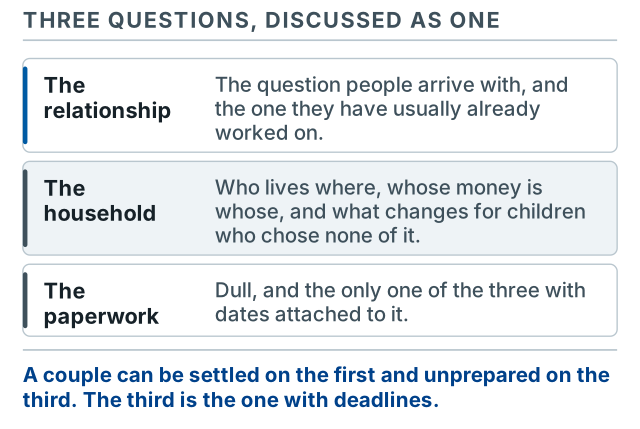
Three separate questions that get discussed as one. The first is about the relationship, and it is the one people arrive with. The second is about other members of the household — who lives where, whose money is whose, what changes for children who did not choose any of it. The third is administrative and dull, and it is the one that produces the expensive surprises: what a wedding date does to payments, entitlements and documents that already exist.
Separating the three is most of the work. A couple can be entirely settled on the first question and completely unprepared on the third, and the third is the one with deadlines attached to it. The money and paperwork section exists for that part.
Why do the published figures on second marriages disagree?
Because they are counting different things, and most of them name no publisher at all. Some count marriages, some count people; some pool remarriage after a divorce with remarriage after a spouse’s death, which households never experience as one thing; some are folklore that has been copied between websites for long enough to sound official.
A remarriage rate is a count of how many previously married people remarry within a given period, expressed per thousand of them. It is not an interval, so it cannot tell anyone how soon a person remarries, and it is not a forecast, so it cannot tell any couple anything about themselves. The page on the second marriage divorce rate works through what the published figures do and do not support, and the page on average time to remarry does the same for timing.
What can research on marriages tell a remarrying couple?
Less than it is usually made to say. The best-known prediction work — Gottman and Levenson’s 1992 study of marital dissolution and the 2000 newlywed-stability study by Carrère and colleagues — was carried out on married couples in general, not on remarriages, and not on households with stepchildren in them. It describes what researchers observed in the samples they had. It is not a test anyone can sit, and it produces no odds for an individual couple.
That gap matters here more than on a general marriage site, because the features that make a remarriage distinctive are the ones the research was not designed around. Consider a couple where one partner’s children are in the house midweek and the other’s are there at weekends: nothing in a study of newlywed interaction speaks to that arrangement, and a page that implied otherwise would be selling a borrowed authority.
What has to be settled before a date is set?
The items that flip on the wedding date rather than gradually. Marital status is the switch several systems run on — benefit schemes, pension and survivor provisions, insurers, employers, and in some places an existing will — and each of them reads the date on its own terms without asking whether anyone has checked. A definition that felt academic in the autumn becomes a dated fact in the spring.
The practical form of that is a list of questions with a named holder for each: the agency or plan administrator that holds your own record, an estate lawyer where you live and hold property, the registry that will register the marriage, and the employer or insurer that covers a partner or stepchildren. Each page in this section ends with its own version of that list. None of them answers the questions, because the answers differ by jurisdiction and change over time, and a specific answer written here would be wrong somewhere and out of date eventually.
Which page here answers what?
Five, and they are deliberately narrow. Remarriage meaning is the vocabulary page, for when a form and a household are using the same word differently. Second marriage divorce rate is where the numbers get examined rather than repeated. Average time to remarry handles timing, including the legal question of how soon a marriage can be registered. Successful second marriage collects what couples themselves name when they say it works, without turning it into a promise. Remarrying the same person covers the case that gets the least written about it.
Pages elsewhere on the site pick up where these stop. Questions about children and households go to the blended family section, questions about the stepparent role to stepparenting, and anything with a legal or financial consequence to money and paperwork, which carries the disclaimer that governs all of it.
Where this section stops
At the border of anyone’s own case. This site does not know your jurisdiction, your record with any agency, or what is in your will, and it will not guess at any of the three. Where the question is legal or financial, the answer belongs to a family lawyer, an estate lawyer, or the administrator holding the account. Where the question underneath the search is whether this particular marriage should go ahead, the useful conversation is with a couples counsellor or a family therapist who works with remarriage and stepfamilies — not with a website, including this one.