
Second marriage finances are the money and paperwork consequences of marrying again when both people already have a financial life: property, pensions, policies, debts, and in most cases children with an interest in some of it. None of it merges quietly, and almost none of it merges automatically in the direction people assume.
Everything below is written as a question with a named counterparty. That is not modesty. The law governing prenuptial agreements, wills, property, survivor benefits and insurance eligibility differs by jurisdiction and changes over time, so these pages state no rule, quote no threshold, and print no figure. What they do is make sure nothing goes unasked.
What are the questions that actually have to be asked?
Five categories, and they recur on every page here. What each of you owned before this marriage, and what happens to it in either direction. What the surviving spouse receives and what the children receive if one of you dies first. Who is currently named on each policy and account. Whether marrying changes any payment either of you receives or makes. And whose name is on the home, which is three separate questions — occupancy, ownership and inheritance — wearing one coat.
The docket above this text is that list in full, with the counterparty for each item. Each page below ends with its own narrower version. The pattern is deliberate: a household that has worked through the questions has done the part that is actually theirs to do.
One of those items has a public paper trail worth knowing exists. In the United States, child support amounts are set by state guidelines rather than nationally, because the federal regulation on child support guidelines requires each state to establish its own set and review them at least every four years. That regulation fixes no amount and says nothing about how a remarriage or a new spouse’s income is treated — those are state questions with state answers. It is quoted here for one reason only: to show that “it depends where you live” is the structure of the thing rather than an evasion.
Why does a document written before the marriage stop working?
Because several of them were written for a household that no longer exists, and they do not notice on their own. A will is an instruction about an estate that takes effect on death and can be superseded, in some places altered, by events that happen after it is signed — which is why the estate planning page treats “we already have wills” as the start of the conversation rather than the end of it.
A beneficiary designation is a separate instruction, held by the provider of a policy, pension or account, naming who receives it. It sits with that provider rather than with the will, and it is not amended by rewriting the will. Consider a life policy taken out during a first marriage: the name on that form is whatever was written then, and it stays that way until somebody contacts the insurer. This is the item households report missing most often, and it is the cheapest one to check.
Which questions belong to a professional, and which belong to the couple?
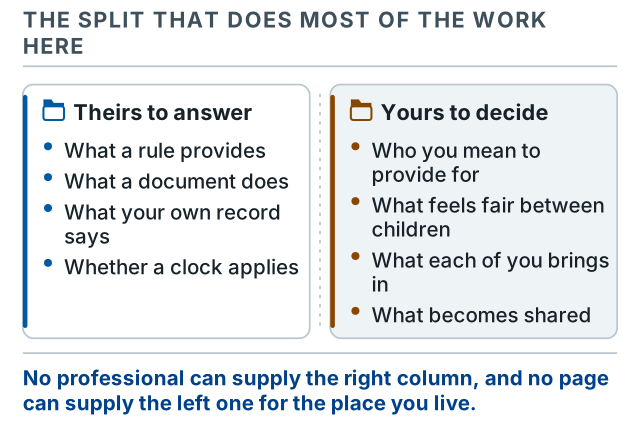
The split is clean, and keeping it clean is most of the value here. What a rule provides, what a document does, and what any of it means for your own record: a family lawyer, an estate lawyer, or the administrator that holds the account. What you actually want to happen — who you intend to provide for, what feels fair between children from different marriages, what you are each bringing and what becomes shared: that one is yours, and no professional can supply it.
A prenuptial agreement is a contract made before a marriage setting out what the two people intend in defined circumstances; whether and how far it binds anything is a question for a lawyer in the relevant jurisdiction. The prenup page is therefore mostly about the conversation — what second-marriage couples report wanting to record, and how they raise it without it reading as a verdict on the marriage.
What tends to go wrong?
Assumption, in both directions. Assuming a stepchild is provided for, or assuming they are not. Assuming a form filed years ago says what it would say if filed today. Assuming that because two people agree, the institutions holding the money agree as well. And assuming that a question with no obvious cost attached — for example whether a stepchild can be added to an employer health plan, and by when — has no deadline attached either.
Deadlines of that kind are real, and where they exist they are usually specific. The rule for United States federal civil service retirees is one narrow published example: the regulation on electing a survivor annuity after a post-retirement marriage gives someone who marries after retiring a fixed window in which to elect a reduced annuity for the new spouse. That is one scheme, in one country, for one group of employees — not a statement about pensions in general, and certainly not about yours. It appears here only to show that a clock of that kind can exist at all, which is the reason to ask your own scheme’s administrator early rather than after the wedding.
The pages on stepchildren and inheritance, health insurance for stepchildren and remarriage and Social Security each take one of those assumptions apart and name the desk that holds the real answer.
Where this section stops
At your own case, always. Nothing here is legal, tax or financial advice, and nothing here should be used in place of asking. The right sequence is the one every page repeats: write down the question, identify who holds the answer for your record and your jurisdiction, and ask them before the date is fixed rather than afterwards.