
Can a stepparent discipline a child?
Stepparent discipline is the everyday business of correcting a partner’s child — who does it, over what, and with whose backing — and it is decided inside each household, very differently from one to the next. There is no general rule that transfers from one family to another, and this page does not supply one.
What exists instead is a range of arrangements that families describe using, plus the reasons they give for choosing them. Reading the range is more useful than being handed a single answer, because the answer that works in a house depends on the child’s age, the custody schedule, how long the adults have been together, and what the other household does.
Two things are worth separating before anything else. The legal question — what a stepparent may do in a given jurisdiction, and what a custody order says — is not the same as the household question of who corrects whom at the dinner table. A custody order is a court document setting out the arrangements for a child, and it is the one input here that the two of you cannot renegotiate between yourselves. The household question is negotiated between adults. The legal one is not.
What approaches do families actually describe?
Four patterns come up repeatedly in how blended families talk about correction. They are descriptions, not recommendations, and most families move between them rather than picking one and staying there.
Correction stays with the biological parent. The stepparent runs the household — meals, lifts, homework time — but anything that counts as discipline is handed to the child’s own parent. Families who describe this usually say it lowers the temperature early on. They also describe the cost: it can leave the stepparent managing a house they cannot enforce, and it falls apart on evenings when the biological parent is not there.
House rules belong to the house. The adults agree the rules together in private, then the biological parent presents them to the children as joint rules. Either adult can hold the line on matters such as bedtime, screens or how people speak to each other, because the rule is attached to the house rather than to a person. Families describe this as needing the adults to genuinely agree first — a rule the stepparent believes in and the parent quietly does not tends to be tested and dropped.
Safety now, everything else later. A narrower version: the stepparent intervenes without hesitation where someone could get hurt, and stays out of the rest. The line between the two categories is drawn between the adults in advance rather than improvised. For example, a household that puts the road and the kitchen in the first category and homework and tone in the second has settled the boundary before anything happens rather than during it.
Full co-parenting. Both adults correct, both are called on it, and the arrangement is treated as ordinary parenting. This is described more often in families where the children were young when the households merged, or where a stepparent adoption has taken place, and much less often where teenagers have another involved parent.
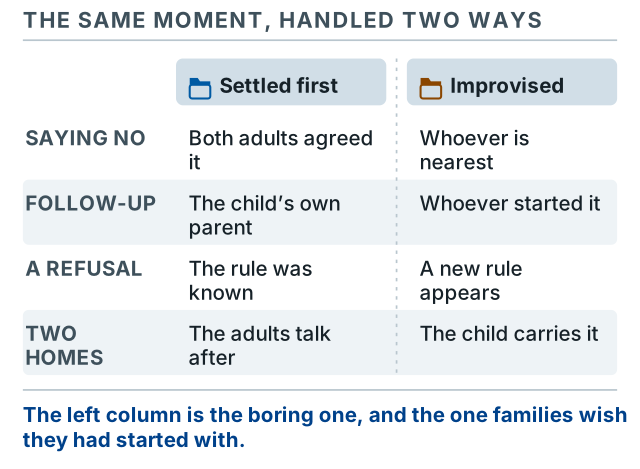
None of these is endorsed here. What the accounts have in common is not the arrangement but the sequence: the adults settle it between themselves before it is tested in front of a child.
The published research nearest to this is not about correction at all. Ganong and colleagues’ 2019 study of stepfathers in the Journal of Family Psychology looked at affinity-seeking — the effort a stepparent puts into building the relationship — and reported it as associated with better stepfather–stepchild relationship quality and greater stepfamily cohesion. It studied stepfathers, with mothers also reporting; the association is not a demonstration of cause; and it hands nobody a technique or a ranking of the four arrangements above. It is included because it is one of the few things on this subject that can be traced to a named journal, an author and a year.
Why is being a stepparent so hard?
Because the responsibility arrives before the standing does. A stepparent is expected to care, contribute and hold the routine from early on, while having little authority in the child’s eyes and, in most situations, none on paper.
Two other pressures show up in most accounts. The role has no agreed script — nobody can say what a stepparent is supposed to be, so every household invents it, usually while under load. And the job is judged by people who are not in the room, including an ex-partner, extended family on both sides, and sometimes the children’s friends’ parents.
There is also the quiet arithmetic of loyalty. Stepparents commonly describe warmth and resistance arriving from the same child in the same week, and describe reading it as pressure between two households rather than as a verdict on them. Naming it that way does not make it stop.
How do families draw boundaries with stepchildren?
Boundaries in this context mean two separate things, and mixing them is where conversations go wrong.
The first is rules about how the house runs. House rules are the expectations attached to the address rather than to a person — what time things happen, what is shared, how people speak to each other — and they are normally agreed by the adults and, in the accounts families give, announced by the biological parent rather than the newcomer.
The second is the stepparent’s own limit — what they are willing to take on and what they are not. Homework battles, for instance, or being the one who searches a bedroom, or handling conversations about the other household: a stepparent can decline any of these. Families describe that refusal landing much better when it is raised with the partner in private, framed as a division of labour, and not delivered in the middle of an incident.
Boundaries with the adults matter as much. Where correction is handed back and forth without warning, or where one adult overrules the other in front of a child, families describe the same outcome regardless of which approach they had chosen: the rule stops meaning anything.
What happens when the two households disagree?
Different houses will have different rules, and households commonly describe leaving the two sets different rather than forcing a merge. What families describe as corrosive is not the gap between the houses but a rule inside one house that changes depending on which adult is in the room.
Where the disagreement is between households and it concerns schedules, decisions or anything set out in an order, that is a matter for the parents and, if it does not resolve, for a mediator or a lawyer. A mediator is a neutral third party engaged to help two sides reach an agreement they will both keep to, without deciding the matter for them. A stepparent negotiating directly with their partner’s ex about discipline is described by most families as a route with a poor record, whatever the intentions.
Who comes first in a blended marriage?
Families answer this in opposite directions, and both answers are common enough that neither can be presented as the correct one.
One camp treats the couple as the foundation: if the marriage is unstable, they argue, nothing built on it holds. General couples material tends to sit on that side — Sue Johnson’s Hold Me Tight is about the bond between two adults and is not written about stepfamilies, stepchildren or households that merge, so it settles nothing about this argument. The other treats the child’s adjustment as the thing that sets the pace, particularly in the first year after households merge, and accepts that the couple carries the cost of that for a while.
A couple who disagree here are not making a mistake — they are describing a genuine difference in what they think this stage requires. It is a conversation worth having before it surfaces as an argument about a specific evening. The logistics side of the same question sits in moving in together, and the standing question — what a stepparent can and cannot do without a court’s involvement — sits in step-parent rights.
Settling it before the household merges
Discipline is one of the few subjects where a couple can be genuinely aligned in principle and completely unaligned in practice. These are the questions families say they wish they had asked earlier, with the person best placed to answer each.
Where this page stops
This page describes what families report doing. It does not assess your household, your partner, your stepchild, or anyone’s behaviour, and it does not tell you how another person’s child should be raised.
Some situations need a professional rather than a page. Sustained conflict that is not easing, a child who is withdrawing or distressed, disagreements between the adults that keep returning to the same argument, or anything about discipline that involves a court order — those go to a family therapist, a mediator, or a family lawyer, depending on which kind of question it is.
If anyone in the household is at risk of being hurt, that is not a discipline question and not a question for a website. Contact emergency services or a helpline in your country.
For the rest of the role — what stepchildren call you, how the first year tends to run, what sits with the lawyer rather than with the two of you — the stepparenting hub collects the pages, and blended family tips covers the everyday logistics that sit underneath most discipline arguments.