
A stepparent is the spouse or partner of a child’s parent — a role in a household rather than a status conferred by the wedding. The daily version of it can be substantial: school runs, meals, bedtimes, the whole texture of a week. The formal version, in most places, is much thinner than that, and the distance between the two is the single thing this section exists to make visible before a wedding rather than after.
The arrangement itself is not unusual, though the published counts are narrower than the word suggests. NCFMR’s profile of stepfamilies among cohabiting and married women under 45, drawing on the United States National Survey of Family Growth, tracks how the share of those coresidential unions that were stepfamilies moved between 1988 and 2017, and finds it rising. That population — women under 45, living with a partner, in one country — is the whole of what it measures. It counts no stepfamily formed later in life, and it says nothing whatever about how any of them work.
Nothing here states what any rule provides. Legal parenthood is a status recognised by a court or registry, arising from birth, adoption or an order, and it carries duties and rights that a marriage to a parent does not by itself create. Where that boundary sits in your case is a question for a family lawyer in your own jurisdiction and for whoever holds any custody order, and this site names the question rather than guessing the answer.
What does the stepparent role actually contain?
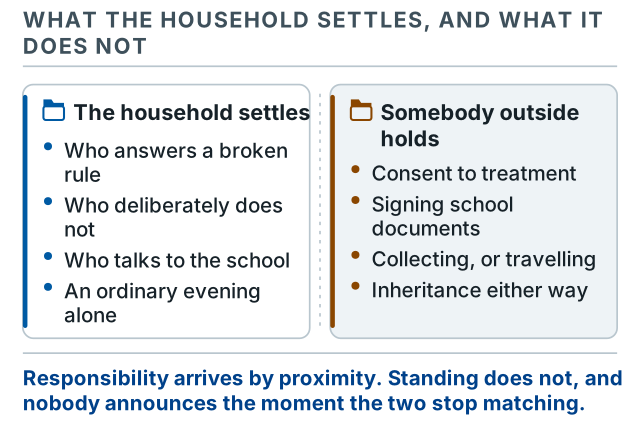
Whatever the two adults agree it contains, plus whatever the household’s routine hands over by default. That second half is where the trouble is: responsibility arrives by proximity, standing does not, and nobody announces the moment it happens.
The practical form is a short list that is better settled in words than by drift. Who responds when a child breaks a house rule, and in what words. Who does not respond, and says so. Whether the stepparent is the one who contacts the school, or never is. What happens on an ordinary evening when the parent is out. Consider a weeknight where a child refuses something at bedtime and only the stepparent is in the house: households that had never discussed it report finding out their two answers differed at the worst possible moment. The page on stepparent discipline works through the approaches families describe, without recommending one.
Which questions are not the household’s to settle?
The ones with an external holder. Consent to medical treatment, signing school documents, collecting a child, travelling across a border with them, and anything about inheritance in either direction are decided by law, by a custody order, or by the institution’s own documentation rules — not by agreement at the kitchen table, however reasonable the agreement is.
A custody order is a court’s standing decision about who holds responsibility for a child and on what terms, and institutions such as schools, clinics and border officials generally apply it alongside their own rules. That is why step-parent rights is written as a list of questions and counterparties: the categories are stable, and the answers are not portable between one jurisdiction and the next.
What do families say is hardest about the role?
Not the tasks. What households name repeatedly is the mismatch — doing the work of a parent while holding the standing of a guest, and having no established word for it. There is no script and no title, which is also why the naming question is its own page rather than a paragraph.
The peer-reviewed work that comes closest to this is narrower than the complaint. A 2019 study by Ganong and colleagues in the Journal of Family Psychology examined stepfathers’ affinity-seeking — the deliberate work of building the relationship rather than assuming an authority — and reported it as associated with better stepfather–stepchild relationship quality and greater stepfamily cohesion. It studied stepfathers, with mothers also reporting, so it does not generalise to stepmothers; the association it found is not evidence that one thing causes the other; and it supplies no method to follow. What it does is put a published finding behind an unglamorous point: in this role the relationship is built rather than conferred.
A term of address here means simply what a child calls the stepparent day to day, and it is a household matter with no legal content at all. What it is not is a test of the relationship. The page on what stepkids call a stepparent sets out what families report using, including the common outcome of no name at all, and what the adults are better off agreeing before the question arrives.
Does adoption change the answer?
It changes the legal question entirely, which is precisely why it is treated separately and briefly. Stepparent adoption describes what the process generally involves and what it is not — it is not a formality, it is not a way of settling a naming question, and it has consequences for the child’s other legal parent that no website can walk anyone through. It is short on purpose, and it ends where a family lawyer begins.
Where this section stops
At every point where the answer depends on jurisdiction, on a custody order, or on a particular child. Legal standing goes to a family lawyer; anything touching inheritance goes to an estate lawyer and to money and paperwork; a contested question about how the adults handle a child goes to a family therapist or a mediator. The blended family section covers the household side — merging two homes, rules, and the first year — and picks up where the role itself leaves off.