
Do stepparents have any legal rights by default?
In most jurisdictions, no. Marrying a child’s parent creates a family relationship socially and a step-relationship in ordinary language, but it does not usually make anyone a legal parent or a guardian. The legal line normally still runs between the child and the child’s two legal parents.
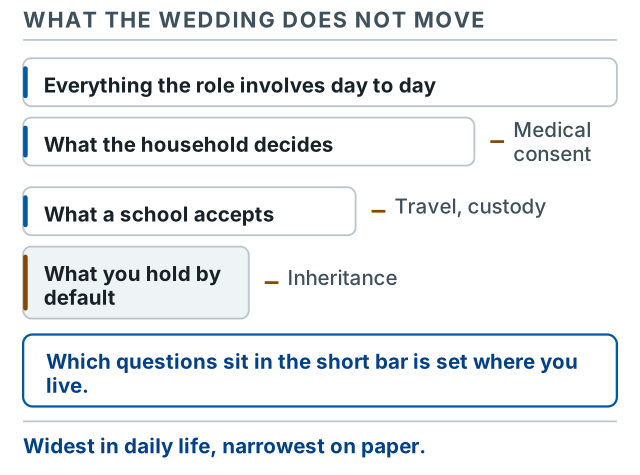
Step-parent rights are the permissions and standing a person holds towards a spouse’s child — consent to treatment, access to records, authority to travel, a claim on an estate — and in most systems none of them is conferred by the marriage itself. That is the whole of the surprise, and it is the reason this page exists. People expect them to arrive with the marriage certificate, in proportion to how much of the daily work they do. They generally do not. Standing has to be created deliberately, by a document or a court, and what is available differs from one place to the next.
How families feel about a step relationship is a separate matter from what it confers, and the feeling has at least been surveyed. Pew Research Center’s portrait of stepfamilies, fielded by telephone among United States adults in 2010, found people reporting a real but weaker sense of obligation towards step relatives than towards parents and grown biological children. That is a measure of stated feeling, in one country, at one moment. It carries no legal weight at all — which is the gap this page exists to describe.
Why does this matter before the wedding rather than after?
Because the questions surface at the worst possible moment otherwise: at a hospital desk, at a school office, at an airport, or in a solicitor’s room after a death. None of those is a good setting for discovering that a form was never signed.
Raised before the wedding, most of these are dull administrative items with a clear counterparty. Raised in an emergency, the same items are a crisis with an audience. Consider a household where one partner’s children are there midweek: whether the step-parent may collect them from school is a question with an answer, and the school office holds it long before anyone needs it.
Which categories cause the surprises?
Four keep coming up in what step-parents describe: medical decisions, school, travel, and inheritance. They are worth separating, because they are answered by different counterparties — such as a school office, a medical practice, a border authority and an estate lawyer — and none of the answers can be inferred from another.
Medical decisions
Consent for treatment is generally tied to legal parental status, not to marriage or to who drives the child to appointments. Providers also differ in what they will accept in a non-emergency. Some families ask the child’s legal parents to put something in writing with the practice and the school; whether that carries weight, and in what form, is a question for a lawyer where you live, not for a template found online.
School
Schools deal in records, pick-ups and emergency contacts, and each of those is a separate permission. An emergency contact is simply the person a school will telephone when something happens, which is narrower than it sounds: being on that list is not the same as being entitled to see a record, and neither is the same as being allowed to make a decision. The school’s own policy answers the first two; the law behind them answers the third.
Travel
Taking a stepchild across a border tends to be where the gap becomes visible fastest, because carriers and border officials apply their own documentation rules on top of the law. What is required varies by destination and by the child’s citizenship. The people who actually answer this are the relevant authority and the carrier, checked before tickets are bought.
Inheritance
This is the category that produces the most pain, usually years later. In many systems stepchildren do not inherit by default, and neither does a step-parent from a stepchild. A will, a beneficiary form and a trust are separate instruments and can contradict each other. A beneficiary designation is the instruction attached to a policy or an account naming who receives it, and it generally operates on its own terms rather than through a will. For example, a policy taken out long before the remarriage will still name whoever it named then. That subject has its own page here: stepchildren and inheritance.
Does adoption change the answer?
Step-parent adoption is the court process by which the spouse of a child’s legal parent becomes a legal parent of that child, which changes the legal relationship itself rather than adding permissions around the edges of it. It also normally involves the child’s other legal parent losing or giving up their status, which is why it is a court matter and rarely a quick one.
That makes it a serious decision rather than a paperwork upgrade, and it belongs with a family lawyer from the first conversation. This site keeps stepparent adoption deliberately short for the same reason: the useful part is knowing which questions to bring and to whom.
Can a step-parent discipline a child?
Everyday household rules and legal authority are different questions, and only the second one is a matter of law. Families describe a wide range of arrangements: some leave all correction to the biological parent, some agree shared house rules that both adults enforce, and plenty sit somewhere in between and move over time.
None of those is recommended here. What families do report is that the arrangement works better when the adults settle it between themselves rather than in front of the child, and when it is revisited as the child gets older. The longer version is on stepparent discipline.
What happens if the marriage ends or the parent dies?
Both events tend to remove the thing the step-relationship was resting on. Where marriage created no legal standing in the first place, ending it usually leaves none behind, and in many systems a step-parent has no automatic route to contact afterwards.
Some jurisdictions have processes that let a person who has acted as a parent apply for something; many do not, and the terms and thresholds vary widely. California is one state that has written something down: its Family Code section 3101 allows a court to grant a stepparent reasonable visitation where that is in the child’s best interest, and provides that it must not conflict with a birth parent’s existing custody or visitation rights.
That is one state’s statute, quoted here only so that a reader knows what such a provision looks like where it exists. It is not the law in the other forty-nine, it is not the law outside the United States, it can be amended, and nothing in it makes stepparents rights-holders generally. Whether anything comparable exists where you live is precisely the sort of question this page will not answer with a rule. Ask a family lawyer there, while there is still time to act on the answer.
Where this page stops
This page describes categories of question and who answers them. It does not state what the law is anywhere, and nothing here should be treated as legal advice or relied on in a dispute. For anything with a date, a court, or a child’s health attached, the answer comes from a family lawyer, an estate lawyer, the school, the medical practice or the relevant authority — in your jurisdiction, about your family.
Where the difficulty is not legal but about how the household is working, a family therapist or a mediator is the appropriate route. If a child’s safety is involved, contact your local emergency services or a helpline in your country rather than reading further.
The rest of the role — the parts with no paperwork at all — is covered across being a stepparent.