What do you say in wedding vows for a second marriage?
You say fewer things, and you mean them more narrowly. Wedding vows second marriage are narrower by design than first-wedding vows: the sweeping declarations come out, and what goes in is a set of promises that could be tested next month — how money gets discussed, what happens when someone wants to stop talking, what each adult will and will not do with the other’s children.
The reason is not that the second time is less romantic. It is that both people have heard absolute promises before, sometimes from each other’s predecessors, and a vow that overreaches now lands with a small delay in the room. Specific promises do not have that problem.
That is the whole shift. Everything below is how couples handle the parts around it: the standard wording, the previous marriage, the children, and the drafting itself.
What are some good vows to use for a second marriage?
Good second marriage vows name a behaviour, not a feeling. A vow is a promise about conduct that the other person can hold you to, and feelings do not qualify — nobody can guarantee an emotional state for thirty years. Conduct can be promised, and conduct is what the other person has to live with.
Lines that recur, in various wordings, in vows couples write the second time:
- To tell you what I have actually spent and actually owe, before you find out another way.
- To bring a problem to you while it is still small and boring.
- To keep your children out of any argument that belongs to us.
- To stay when the house is difficult, not only when it is good.
- To say when I am wrong without waiting to be proved wrong.
- To keep making room for the people who were here before me.
None of these is a template to lift whole. They are the shape: one promise, one sentence, no adjectives doing the work. A vow that survives being read back in five years is usually one that named something that could have been broken.
Which vow structure do couples choose the second time?
Three structures cover most second weddings, and the choice is mainly about how much of the ceremony each couple wants to author themselves. Standard wording refers to the words the ceremony itself supplies, the same for whoever is marrying, and it is the part a couple does not write.
| Structure | What it involves | What couples say it suits | The trade-off |
|---|---|---|---|
| Standard wording only | The vows required or offered by the officiant, registrar or faith tradition, unchanged | Small ceremonies, mixed guest lists, anyone who does not want to perform | Says nothing about children, money or history — those go elsewhere in the day, or nowhere |
| Standard plus a personal section | Required wording first, then a short written passage each | Most second weddings, by the accounts officiants describe | Two registers in one ceremony; the personal half has to be genuinely short to work |
| Fully written vows | Both people write everything, within whatever the ceremony legally requires | Couples who have done a formal first wedding and want the opposite | Most drafting work, and the highest risk of a speech rather than a promise |
The middle row is where most second weddings land. The required wording carries the legal and traditional weight; the written section carries what is different about this marriage, which is usually the part the guests came to hear.
Should second marriage vows mention a first marriage or a late spouse?
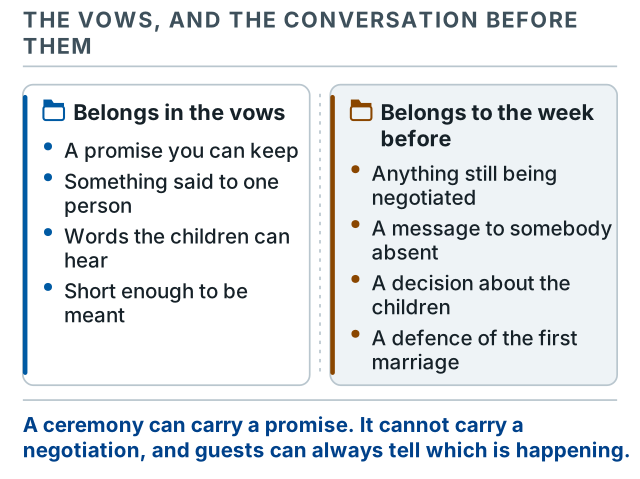
There is no rule, and the two situations pull differently. After a divorce, most couples leave the previous marriage out of the vows entirely. After a death, many families want it acknowledged somewhere, and the common solution is to place that acknowledgement in the ceremony rather than inside the promises.
Ways couples handle it: a reading, a named seat, a photograph on a side table, a line in the officiant’s welcome, or a private moment before the ceremony that the guests never see. All of these keep the vow itself forward-facing while refusing to pretend a whole life did not happen.
What tends to go badly is a vow constructed as a comparison — a promise defined by what a previous partner failed to do. It puts an absent person in the centre of the sentence and gives the guests somewhere else to look.
Where an ex-spouse is still part of the logistics, the ceremony is not the place to settle it. That belongs to the scheduling conversations covered across the blended family hub, not to a microphone in front of forty people.
What about vows to stepchildren?
Many second weddings include a promise to the children, and families do it very differently, in forms such as a separate short vow spoken to each child, a single family promise spoken by both adults, a gift or a token instead of words, or nothing at all in the ceremony.
The decision that matters is made before the wording: whether the children want a role. Some want to be at the centre of it and some would rather not be looked at by a room full of adults, and this is worth asking directly rather than assuming. A child who declines is not rejecting the marriage.
The full version of this question — what to promise, what a stepparent can honestly commit to, and how families phrase it — sits on its own page: blended family vows.
Who decides the wording — and who do you ask?
Part of a wedding ceremony is the couple’s to write and part of it is not, and which part is which depends on the country, the officiant and the tradition. An officiant is whoever conducts the ceremony — a registrar, a celebrant, or a faith leader — and what they will and will not allow is theirs to state rather than a website’s to guess. This is a question with a counterparty, so it is worth asking rather than assuming.
How couples actually write them
Draft separately, then agree the frame together. Couples who compare drafts before the day usually do it to match length and register rather than content: two vows of wildly different lengths, or one comic and one solemn, is the mismatch people notice afterwards.
A method officiants describe: write everything down first without editing, then cut every line that is not a promise. Descriptions of the other person, however true, are not promises — a line praising their patience with your children, for example, is a compliment, and the promise hiding underneath it is the part worth keeping. What is left is short, which is the point.
Then read it aloud, standing, to someone who is not the person you are marrying. Vows fail on the page far less often than they fail in the mouth. Anything that cannot be said steadily out loud gets cut, and the crying point usually arrives earlier than people expect.
Keep a copy on paper in someone else’s pocket. That advice is unglamorous and it is the one officiants repeat most.
What this page won't do
The second-wedding corner of the internet has a particular set of habits. These are the ones we're staying out of.
- Sell you a vow template as a finished product
- Generated and copy-pasted vows read as generated, most obviously in a room of people who have been to your first wedding. The examples above are shapes, not scripts.
- Promise that better vows make a better marriage
- A ceremony is a few minutes long. Nothing said in it predicts how the household handles money, schedules or someone else's children.
- Tell you what to promise a child who is not ours
- We describe what families do. Which promise a stepparent can honestly make to a particular child is theirs to decide, not a website's.
- Print a statistic about second marriages to frame your vows
- Figures on remarriage vary by cohort, year and definition, and we publish numbers only with a named source behind them. There isn't one here, so there is no number here.
Where this page stops
This page is about wording and ceremony. It is not legal advice, and it does not settle anything about property, wills or existing arrangements — those questions go to a family lawyer or an estate lawyer, and the questions worth asking are collected across money and paperwork.
Where the difficulty is not the vows but grief, or a child’s distress about the marriage, a bereavement counsellor or a family therapist is the right next step rather than a better draft. If anyone involved is in crisis, contact a helpline in your country or local emergency services.
The rest of this hub — format, guest lists, cost and custom — is at The wedding, again, and the practical planning questions sit with second wedding ideas.