What are blended family vows?
Blended family vows are promises spoken to the children in the room as well as to the person being married. In practice they are short, they name specific behaviour, and they sit after the couple’s own vows rather than replacing them. A ceremony is not a legal act; a stepparent’s standing comes from law that differs by jurisdiction, and that question goes to a family lawyer rather than to a celebrant.
That is worth saying plainly because the ceremony can feel like a threshold. The legal position of a stepparent is set out elsewhere on this site, it varies by where you live, and it is not something a wedding is asked to settle in either direction.
What the vows do is public and social. They tell the children what to expect from the adult moving in, and they tell everyone else in the room how this household intends to describe itself.
Should the children be part of the ceremony at all?
Families split on this, and the split is usually about the child rather than about the occasion. A younger child who has been asking when the wedding is and a teenager who has not mentioned it once are not being offered the same thing when they are handed a role.
Reasons families give for including children: the marriage is visibly a household event, not a private one; leaving a child in the audience can read as an answer about where they stand; and children often want a job to do rather than an hour of being looked at.
Reasons families give for keeping it a couple’s ceremony: a child who is still ambivalent should not have to perform agreement in public; a stepchild may feel that participating is a statement about their other parent; and some children simply hate being watched.
The workable middle is offering rather than assigning. A role that can be declined without a scene — and declined the week before, not on the morning — is a different proposition from a role that has already been printed in the order of service.
What do vows to stepchildren usually say?
Most of the wording families keep is behavioural and modest: to be there, to listen, to learn how this family already works, to not ask anyone to choose. The vows that age badly are the ones that promise a feeling or a title — “I will love you as my own”, for example, is a promise about an interior state that nobody in the room can check.
Patterns that recur in ceremonies families describe:
- Presence rather than authority. “I will be here” outlasts “I will guide you.”
- Named specifics. A promise about school runs, or about a shared hobby, is one the child can check against the following Tuesday.
- Respect for the household that already exists. Something that acknowledges the other parent, or at least does not write them out of the sentence.
- Room to change. Language that leaves the relationship space to become whatever it becomes, rather than declaring what it already is.
- Length. Shorter than the couple’s vows, said once, not built into a set piece.
The word choice around parenthood is the sharpest decision in the whole paragraph. Families who avoid “mother”, “father” and “parent” in the vows generally do so for the same reason they avoid them at home: the child gets to decide what to call the adult, and that decision often takes longer than an engagement. The naming question has its own page — what stepchildren call a stepparent.
What do families leave out?
Three things come up repeatedly as regrets: promising to be a parent, promising forever on the child’s behalf, and promising anything about the other household.
Promising to be a parent puts a child in an impossible position in front of an audience. If they have a living, involved parent elsewhere, the sentence asks them to either accept a replacement or visibly refuse one, with relatives watching.
Promising on the child’s behalf — “we will be a family from today” — describes a change the adults have decided and the children have not necessarily arrived at yet. The couple has usually had a long run-up to this day. For the children it may be the first fixed point in a process they did not start.
Promising anything about the other household is the version most likely to travel. Wording that sounds like a comparison, or like a promise to do what the other parent does not, tends to be repeated at handover and is difficult to walk back.
What roles do children take besides speaking?
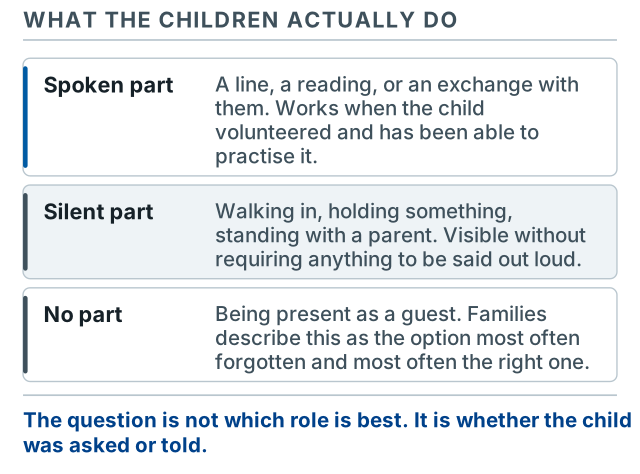
Non-speaking roles are the most common, because they let a child be visibly included without being asked to declare anything. Walking a parent down the aisle, handing over rings, holding flowers, standing with the couple, reading a short passage chosen by them, or signing as a witness where local practice allows it — the point is participation without performance.
A unity ritual is a shared piece of the ceremony involving the whole household, such as pouring sand, lighting a candle together or exchanging a small gift. These are customs, not requirements, and families who skip them are not skipping anything official. A ritual works when it fits the household’s tone and falls flat when it is borrowed from a wedding that had nothing in common with this one.
Two practical notes families mention. Rehearse it, so a child knows exactly where to stand and when it ends. And give any child an exit — a seat next to a trusted adult they can return to the moment their part is over.
How does the children’s age change what works?
Broadly, younger children want a job and older children want a choice. That is a generalisation about ceremonies, not a claim about child development, and the children in question are the only reliable source.
Younger children tend to do well with something concrete and brief: carrying, holding, walking. Teenagers more often accept a role with control attached — taking photographs, managing music, being a witness, or being told they can simply sit down. Adult children are a separate case again: many are asked to give a reading or to stand with the couple, and many prefer to be a guest, particularly if the wedding follows a death or a contested separation.
One thing families raise that is not about age at all: a child who is currently unhappy about the marriage may not want a role now and may regret not having had one later. Some households handle this by leaving a small, undeclared place open on the day rather than closing the question weeks in advance.
Who comes first — the spouse or the children?
The ceremony does not have to answer this, and trying to make it answer this is where a lot of blended family vows go wrong. Vows to a partner and promises to children are different kinds of statement, and sequencing them is a matter of structure, not ranking.
The common arrangement is couple’s vows first, family promises after, with a sentence explaining the order so nobody in the room has to interpret it. The alternative — folding a line about the children into the couple’s vows — keeps the ceremony tighter but gives the children less of their own moment.
The underlying question is a real one and it does not belong on a wedding day. It belongs to the ordinary weeks of a merged household, where it shows up as time, money and attention, and where it is discussed in more detail under moving in together.
How is this different from the couple’s own second-marriage vows?
Second-marriage vows between two adults deal with a different problem: what to say when both people have said something like this before, and what to do about the promises that did not hold. Family vows deal with an audience that did not choose to be there.
Most ceremonies need both, written separately and read in the same voice. The couple’s half — including how people handle the fact that the words are familiar — is covered in second marriage vows.
Where this page stops
This page describes what families do in a ceremony. It does not assess any child, and it does not tell any adult how to raise someone else’s child.
Where a child’s wellbeing is the actual question — a child who is distressed about the marriage, or caught between two households — a family therapist is the right next step, and a mediator is the right one for disagreements between households about arrangements. Where the question is about legal standing, adoption, names on documents or inheritance, it goes to a family lawyer rather than to a celebrant. If anyone involved is unsafe or in crisis, contact a helpline in your country or local emergency services rather than reading further.
The rest of this hub is at The blended family.