What are the etiquette rules for a second marriage?
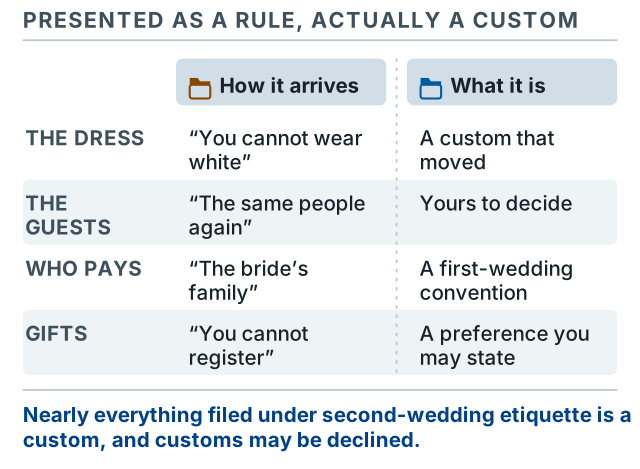
There are almost none left. Etiquette for second marriage is a body of custom rather than a set of rules: until fairly recently it was a list of restrictions — no white, no veil, no church, no bridal party, no gifts, no fuss — and most of those have quietly lapsed. What remains is argued about rather than enforced.
The useful way to read the old rules is as a record of who used to pay and who used to be embarrassed. When a bride’s family funded a first wedding, a second one had no obvious payer, so custom made it small. When remarriage after divorce carried stigma, custom made it quiet. Both conditions have changed, and the etiquette moved with them, unevenly.
That unevenness is the real problem. Nobody is checking a rulebook, but a parent, an ex-spouse or a teenager may still be carrying the version they grew up with — imagine a household where one partner’s mother reads a short register-office ceremony as an apology rather than a preference. Most second-wedding friction is that gap, not a breach of protocol.
Who pays for a second wedding?
Usually the couple. That is the single biggest change from a first wedding, and it simplifies almost everything downstream: people who pay for their own day are not obliged to seat anyone, invite anyone, or hold the kind of event someone else is funding.
Parents sometimes still offer, particularly if they did not contribute the first time or if the first marriage ended young. Accepting is not a breach of anything. The question worth asking before accepting is what comes attached — a guest list, a venue, a religious form — because that is where the old arrangement had its teeth. A contribution towards one item, for example, tends to arrive with fewer expectations than money that covers the day.
| Arrangement | How it usually comes up | What tends to come with it |
|---|---|---|
| The couple pays for everything | Most common now, especially where both have been married before | Full control of size, guest list and format; a budget that competes with a mortgage or children's costs |
| Couple pays, parents contribute to one item | Parents want a part in it without funding the day | Usually no strings, because the contribution is bounded |
| One family funds most of it | More common when one partner has not been married before | The older expectations travel with the money — guest list, venue, sometimes the ceremony's form |
| Guests contribute in kind | Small weddings, at home or at a friend's venue | Informality has to be stated on the invitation or people arrive dressed for something else |
Where the money itself is complicated — property, adult children, obligations from a previous marriage — the wedding budget is the small end of a larger conversation that belongs elsewhere on this site, under a prenuptial agreement and inheritance.
Who should be told first, and in what order?
Children first, then a co-parent, then everyone else. That ordering is the one piece of second-wedding etiquette that most families do treat as close to a rule, and it exists for a practical reason: a child who learns about the marriage from a relative, a social feed or the other parent’s house tends to react to the way they were told rather than to the news.
A co-parent is the other parent of a child from a previous relationship, and telling one before the announcement spreads is a courtesy rather than an obligation. It is usually done in the plainest possible form — that this is happening, and roughly when. It is not an invitation to negotiate the wedding, and it is not the moment to renegotiate anything else.
Adult children are frequently told last on the theory that they need it least. Families report the opposite reaction more often than they expect, particularly where a previous marriage ended in a death rather than a divorce, or where an inheritance is assumed to be in play.
Who gets invited to a second wedding?
Whoever both people want in the room. The guest list is where the old etiquette had the most to say and where it now says the least, so the questions are practical: capacity, cost, and who has to sit near whom.
Three cases come up repeatedly, and none has a settled answer:
- The former in-laws. Common where children keep the connection, and where the previous marriage ended in bereavement. Couples who invite them usually tell them privately first.
- A former spouse. Rare, and it works only where the relationship is genuinely amicable and both partners want it — not where one is being persuaded.
- Friends who were close to the first marriage. Some feel a loyalty conflict. Saying it out loud beforehand tends to be easier than watching who declines.
The other half of the list is the new household’s own logistics, such as which of the children are in the ceremony, whether their friends come, and who supervises younger ones during a long evening. That planning sits with the practical side of the day, collected in second wedding ideas.
Can you wear white, have a bridal party, or marry in a church?
Yes, in most places, and the objections are mostly generational. Dress conventions for second weddings have loosened to the point where the question is now about what suits the size of the event rather than what is permitted. A full gown at a registry office reads oddly for reasons of scale, not morality.
A bridal party is likewise a choice. Attendants are the people who stand with the couple and handle the small jobs of the ceremony, and second weddings often give those places to children instead, or skip the party entirely because the guest list is small enough that nobody needs organising.
Religious ceremonies are the one place where something firmer than custom can apply, because individual traditions and denominations set their own conditions for remarrying someone who was previously married. That is a question for the specific officiant or congregation, and it is answered by them rather than by a general etiquette page.
Gifts, registries and asking for nothing
Guests bring gifts to second weddings unless told otherwise, and the old rule that they should not is gone. A gift registry is a published list of what a couple would like to be given, and that is where the practical problem starts: two established households usually already own the things a registry traditionally lists.
Common responses couples describe: no registry and no mention of gifts, a line asking for contributions to a honeymoon or a house, a charity nomination, or a short registry of things that genuinely need replacing when two homes merge. Any of these is ordinary. None obliges a guest to spend a particular sum, and any “typical amount” circulating online is folklore.
If guests ask directly — and at second weddings they often do — a plain answer saves everyone the guessing.
Where do children fit into the ceremony?
Wherever they have agreed to be, including nowhere. Children’s roles are the part of second wedding etiquette most likely to be decided by adults on a child’s behalf, and the families who report the fewest problems are the ones who asked first and accepted a no.
Roles families use include walking a parent down the aisle, reading, handing over rings, or simply sitting with a grandparent and not performing at all. Some couples make promises to the children in the ceremony itself; that is a whole subject of its own, and it is set out under blended family vows.
A quieter question is what the day signals to a child about the household that ended. A wedding that pretends the previous family never existed tends to be noticed. So does one that turns into a memorial. Most couples find a small acknowledgement — a photograph, an empty seat, a line in a speech — does the job without taking over the afternoon.
What couples say they got wrong the second time
Two things, repeatedly. The first is running the day for an audience — parents, former in-laws, the version of etiquette someone else is carrying — and ending up with an event neither partner chose. The second is the opposite: deciding that because it is a second wedding it should not matter, and then finding that it did.
There is no formula that avoids both. What people describe working is deciding the size and the form first, between the two of them, and treating everything else as information to be delivered rather than permission to be sought.
Where this page stops
This page describes customs, not obligations, and it does not rule on anyone’s family. It gives no legal or financial guidance: anything involving a court order, a parenting arrangement, property or an inheritance goes to a family lawyer or an estate lawyer, and anything involving a religious condition goes to the officiant or congregation concerned.
Where the difficulty is between the two of you, or between an adult and a child who does not want the wedding to happen, a couples therapist or family therapist is a better next step than a planning checklist. If anyone involved is unsafe or in crisis, contact a helpline in your country or local emergency services rather than reading further.
The rest of this hub is at The wedding, again.