
What does remarriage mean?
The remarriage meaning is the one most dictionaries give: marrying again after a previous marriage has ended. The ending can be a divorce, an annulment, or the death of a spouse, and the word covers all three without distinguishing between them.
In ordinary speech the term stretches further than that. People use “remarriage” for the whole arrangement that follows the ceremony — the household, the children, the calendar, the two sets of relatives — and not only for the act of signing a register.
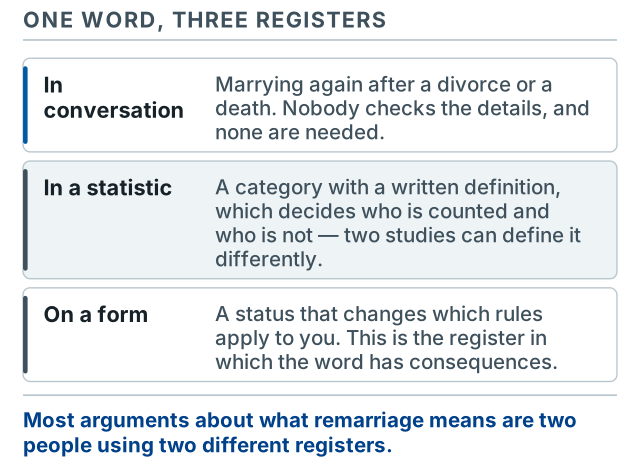
Both uses are legitimate. The confusion starts when a form, a pension scheme or a religious body uses the narrow legal sense while the person filling it in is thinking of the broad domestic one. A benefit form, for example, is usually asking the narrow question, while the person answering it has the broad one in mind. That gap is where the practical problems on this site tend to begin.
Is remarriage the same as a second marriage?
Almost, and the difference is worth a sentence. Remarriage describes marrying again after any previous marriage, so a third and a fourth marriage are remarriages too. “Second marriage” counts a position in a sequence.
Everyday writing treats the two as interchangeable and no harm follows. Statistical work does not, which is one of several reasons figures on the subject disagree with each other; the page on the second marriage divorce rate sets out the rest. It is worth seeing what a careful version looks like: NCFMR’s comparison of first marriages and remarriages describes who is in a remarriage among currently married United States adults, by age, education and race, using American Community Survey data. That is a snapshot of composition — who happens to be in one — and deliberately not a statement about anyone’s chances of ending up there.
There is a further split hidden inside the same word. Remarriage after a divorce and remarriage after a spouse’s death lead to very different paperwork, different family reactions and often a different relationship with the previous partner’s relatives. Research frequently pools the two. Households never experience them as one thing.
When does someone count as “remarried”?
It depends who is asking, and the honest answer is that at least five different bodies can each hold a slightly different one. The table below sets out the contexts where the word is used and what usually decides the answer inside each.
| Who is asking | What 'remarried' usually turns on | Where the answer actually comes from |
|---|---|---|
| Everyday conversation | The wedding happened and the couple live as married | Nobody adjudicates it; the word is loose by design |
| Civil registration | A valid marriage registered after a previous one legally ended | The registry or civil authority in the place of marriage |
| Benefits and pensions | Marital status on a set date, and sometimes the date itself | The official agency or the scheme's plan administrator, on your own record |
| Wills and estates | Whether a marriage changes an existing will or an entitlement | An estate lawyer in the relevant jurisdiction |
| A religious body | That body's own rules about a previous marriage | The clergy or tribunal of that tradition, not a general website |
The table is deliberately blank where readers most want detail. Rules on benefits, estates and religious status vary by country and change over time, and a specific answer written here would be wrong somewhere and out of date eventually. Naming the right desk is the part that stays true.
Why does the exact definition matter before the wedding?
Because marital status is the switch that several systems run on, and they flip it on the wedding date rather than on the day someone thinks to check. A definition that felt academic in the autumn becomes a dated fact in the spring.
Consider a couple who fix a date in the spring and only afterwards ask what the change of status does to a pension or a will: the questions are the same ones, arriving too late to act on.
That the switch is real, rather than a way of making readers anxious, can be checked in the regulation text of at least one country. In the United States, the rule on widow’s and widower’s benefits for a surviving divorced spouse is written around whether the claimant is married, with exceptions keyed to age. Read it for the structure and nothing else: it applies to one benefit in one country, it computes nothing for anybody, and regulations are amended. What your own status switches is a question for the agency or the scheme that holds your record.
The questions below are the ones remarrying couples report wishing they had asked earlier. They are questions, not answers, and each is addressed to the person or body that can answer it.
What is a remarriage called once children are involved?
The household usually acquires a second label. A remarriage where one or both partners bring children from a previous relationship is generally called a stepfamily or a blended family, and the two terms are used more or less interchangeably.
The distinction people ask about most often is between blended and extended. A blended family is made when two households merge into one. An extended family is the wider ring of grandparents, aunts and cousins that exists either way. A remarriage can create the first, and it always enlarges the second, which is part of why the first year of a merged household is busier than anyone budgets for.
Informal alternatives such as “mixed family” turn up as well. The term has no legal meaning and no agreed boundary, so services and researchers tend to avoid it.
One vocabulary point worth knowing: a stepparent relationship is a social role, not automatically a legal one. Marrying a child’s parent does not by itself make someone that child’s legal parent, and it does not by itself create inheritance rights in either direction. That gap between the word and the law is the reason the money and paperwork hub exists.
What does remarriage not mean?
Some of the freight the word carries is not part of the definition at all, and it is worth setting down separately.
What this page won't claim about remarriage
A definition page is a common place to smuggle in a verdict. These are the verdicts this site does not issue.
- That remarriage is a second attempt at the same thing
- The word describes a legal status, not a repeat performance. Treating a remarriage as a retake of the first marriage is a framing, not a meaning, and plenty of remarried couples reject it.
- That a statistic describes your household
- Aggregate figures on remarriage describe large groups over long periods. They say nothing about any one couple, and this site quotes no figure without naming the body that produced it.
- That the word means the same thing everywhere
- Civil authorities, benefit schemes and religious bodies each define it for their own purposes. A definition borrowed from one and applied to another is where avoidable trouble starts.
- That there is a readiness test to pass
- No quiz on this site or any other can tell a couple whether to marry. Scored readiness tests are entertainment dressed as assessment.
Where this page stops
This page explains a term. It cannot say what any rule provides in a particular country, and it does not try to.
For anything touching benefits, pensions, wills or property, the answer belongs to a family lawyer, an estate lawyer, or the agency or plan administrator that holds the record. For the question underneath the search — whether this particular marriage should go ahead — the useful conversation is with a couples counsellor or family therapist, ideally one who works with remarriage and stepfamilies. Where children’s wellbeing is the sticking point, a family therapist or mediator is the route.
If fear rather than uncertainty is what brought someone to a definition page, or if anyone is in immediate danger, that is a matter for a helpline in your country or for emergency services.
The short version
Remarriage means marrying again after a previous marriage ended, by divorce, annulment or death. That much is settled. Everything downstream of it — status on a form, effect on a payment, standing in a faith tradition, position in a household — is defined by whoever is asking, and each of them holds a slightly different version.
The practical move is to treat “remarried” as a status with consequences rather than a description of a mood, and to find out what it switches before the date is set. The rest of the deciding hub works through those consequences one at a time.