
What is a blended family?
A blended family is a household in which at least one adult brings a child from a previous relationship, so the couple is raising a child who belongs to only one of them. That is the whole definition. Everything else people attach to the term — how many children, who lives there which nights, whether the adults have married — varies without changing what the word means.
How many households the word covers depends entirely on who is being counted. NCFMR’s profile of stepfamilies among cohabiting and married women under 45, built on the United States National Survey of Family Growth, tracks the share of those coresidential unions that were stepfamilies between 1988 and 2017 and finds it rising. That is a narrow population by design — women under 45, living with a partner, in one country — so it is not a count of all stepfamilies and includes none formed later in life. It measures who lives with whom, and nothing at all about how those households work.
The term is used interchangeably with stepfamily. Some households also add a child born to the couple, which the definition allows for and does not require. A family formed after a divorce and a family formed after a death both count; the term describes the composition of the household, not how the previous one ended.
What the word does not tell you is the part that matters most in practice: which adult has standing to make decisions about which child. Two households can look identical from the street and be completely different on a school form.
What best describes a blended family, and what does not belong under the label?
The clearest test is whose children are under the roof, not who is married to whom. If the children in the household come from more than one relationship, the term applies. If two people with no children marry and have children together, it does not, however complicated their history.
Adjacent terms get mixed up often enough to be worth separating:
- Stepfamily is the same thing under an older word. “Blended” became common partly because “step” carries centuries of unhelpful storytelling.
- An extended family is defined by generations and relatives, not by whose children they are. A household can be blended and extended at the same time.
- A mixed family means a blended household in some uses and, in others, a family mixed by culture, faith or race. Ambiguous, so worth clarifying when someone uses it.
- Co-parenting household — describes the arrangement between separated parents, which continues to exist alongside a blended family rather than being replaced by it.
The label is worth getting straight for one practical reason. Schools, insurers, plan administrators and courts each use their own definitions, and none of them is obliged to use yours. A child described at home as “our daughter” may be classified quite differently on the form in front of you — on a school contact list, for example, or under an insurer’s definition of a dependant.
What actually changes when two families become one household?
Four ordinary things change at once: space, rules, money and time. They change on the day the boxes arrive, whereas the relationships change on their own schedule, which is longer and not negotiable.
Space stops being private in the way it was. Rules that were obvious in one household turn out to be one household’s habits rather than universal law. Consider a household where one partner’s children are there midweek and the other’s every second weekend: the same kitchen runs to two timetables, and neither set of habits is the wrong one. Money that used to be one person’s decision now arrives with obligations already attached to it — a payment out, a cost for a child only one adult is responsible for. And time alone between a parent and their own child, which used to happen without planning, now competes with a full house.
None of that is a warning. It is the standard content of a first year, and we set the logistics out in detail under blended family moving in together.
The part households tend to underestimate is the difference in starting position. The couple has usually spent months or years arriving at this arrangement. For the children it can be the first concrete consequence of a decision they were not part of, and they begin the same day from a different place.
Does marriage make a blended family legally one family?
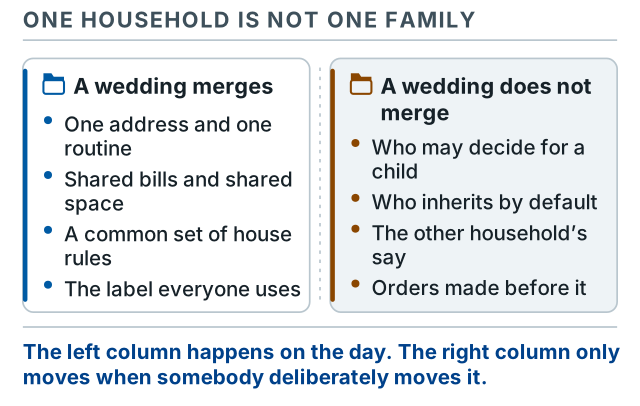
Usually less than people expect, and it is one of the surprises this site returns to most. Marrying a child’s parent does not, by default, make you that child’s parent in the eyes of schools, hospitals, insurers or estates. In most places some form of adoption or a specific legal instrument is what changes that, and the rules differ by jurisdiction.
The reason this hub keeps returning to these questions is that they are cheap to answer before a wedding and costly afterwards. The limits of a stepparent’s default position are set out under step-parent rights, including the estate side that catches most families late.
Who is in charge of the children in a blended family?
Households answer this differently and the honest summary is that there is no settled rule. The range people describe runs from “only a child’s own parent sets consequences” through shared house rules with separate parenting decisions, to full joint authority built up over years.
What most accounts have in common is a distinction rather than a hierarchy. House rules — noise, shared space, screens at the table, who cleans what — apply to everyone under the roof and are usually agreed by the adults together. Parenting decisions about a specific child — bedtimes, phones, consequences — tend to stay with that child’s own parent, at least early on.
This site does not recommend one of those arrangements over another, and does not tell any adult how to raise someone else’s child. What it does say is that the arrangement works better named than assumed, because the alternative is a child discovering the rule and the authority at the same moment.
Are blended families more likely to break down?
Remarriages end in divorce at a higher rate than first marriages by most estimates, and this page will not give you a percentage. No single agreed figure exists: estimates differ by country, by the years the data covers, by whether a cohort is followed for a decade or a lifetime, and by whether cohabiting households count at all.
That is also why the numbers repeated confidently in articles and speeches rarely name a source. Where a figure circulates without one — and most do — treat it as folklore rather than a finding. We take that apart properly under the second marriage divorce rate.
What can be said without a number: the difficulties blended households describe are more often structural than romantic. Schedules set by someone outside the house, money with prior claims on it, and unclear authority over children show up far more often in these accounts than anything about the couple’s feelings for each other.
What do families say makes it harder, and what do they take to someone else?
The patterns named most often are about the adults, not the children: decisions about a child made without that child’s own parent in the room, one adult carrying the household work with none of the standing, money moved without agreement, and rules that apply to one set of children but not the other.
Some of that is a conversation between two adults with a calendar. Some of it is not. Where the friction is about a child’s wellbeing, or where the same argument has been running for months, the useful move is outward — to a family therapist, or to a mediator where the dispute is about schedules and arrangements with a former partner.
There is no readiness test here and there will not be one. A page cannot assess a household it has never met, and the ones that claim to are selling something.
Where this page stops
This page defines a term and describes what households report. It does not assess children, it does not diagnose behaviour, and it does not tell any adult how to parent someone else’s child.
Anything legal or financial — decisions about a stepchild, inheritance, plans, payments, property — belongs with a professional who knows your jurisdiction and your circumstances: a family lawyer, an estate lawyer, the plan administrator, or the agency that issued the order. Where a child’s wellbeing is the question, that is a family therapist or a mediator. If anyone in the household is unsafe or in crisis, contact a helpline in your country or local emergency services rather than reading on.
The rest of this hub is at The blended family.