What does it mean to remarry the same person?
To remarry the same person is to marry someone you were already married to and legally divorced from. In most places that is an ordinary marriage in the eyes of the registrar: the earlier divorce ended the first marriage, and the new ceremony creates a new one.
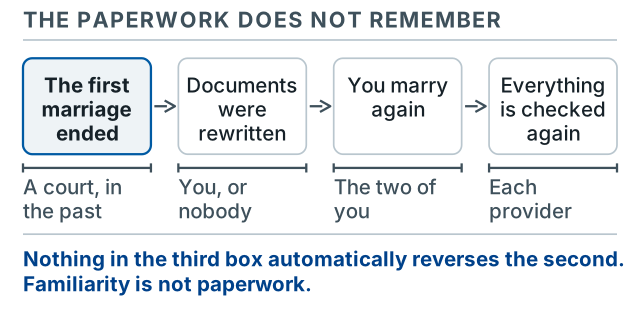
What is not ordinary is everything the divorce set in motion. Property was divided, a home was sold or kept, arrangements for children were written down, and pensions, wills and beneficiary forms were probably redrawn. A second ceremony does not reverse any of it, and it usually touches several of those documents — a will, for example, or a beneficiary form — in ways nobody notices until much later.
That gap — an easy wedding sitting on top of a complicated undoing — is the whole subject of this page.
How common is it to remarry the same person?
Nobody can say honestly, because it is not counted separately. Marriage records are administrative documents that note whether someone has been married before, not whether the new spouse is the same spouse. Because of that, most figures circulating for this are guesses dressed as data.
It is not that nobody counts marriages. The United States Census Bureau publishes a report on the number, timing and duration of marriages and divorces, which is the official picture of marital history: how many times people have married, and how long those marriages lasted. What it does not record — what no such source records — is whether a new spouse is a previous one. The question this page is about falls through the gap in what gets collected, not through any lack of effort.
There is no percentage on this page for the same reason there is none on the page about the second marriage divorce rate: this site prints a figure only when the body that produced it can be named in the same sentence, and for this question nothing clears that bar.
What can be said honestly is qualitative. Remarriages in general end somewhat more often than first marriages, by most published estimates, and the estimates disagree on magnitude because they use different countries, different cohorts, different years and different definitions of an ending. Whether a couple remarrying each other sits above or below that pattern is not something the available research answers.
What actually has to be different this time?
The question most couples arrive with is whether they have changed enough. A more answerable version is: which specific conditions ended the first marriage, and which of them still exist?
Conditions are checkable in a way that character is not. A job that kept one partner away, a debt, an addiction being treated or not treated, a household where one person carried all the domestic load, a third party, a house that never suited anyone — each of these has a present state that can be described in a sentence by both people. Consider a debt that was the standing argument of the first marriage: whether it has been cleared is a question with an answer, where “have we both changed” is not.
Where the answers differ sharply, that is information rather than a verdict. Some couples describe having had that conversation before the wedding rather than after, often with a counsellor in the room, and more than once.
| What the first marriage set up | What the divorce did to it | What decides it now |
|---|---|---|
| The marital status itself | Ended it | The new marriage — a fresh marriage, not a reinstated one |
| Division of property and debt | Settled it, often by court order | Whatever you agree now, in writing, with advice |
| Wills and beneficiary forms | Frequently changed, sometimes overlooked | The documents as they currently stand, not intentions |
| Arrangements for children | Recorded in orders or agreements | The existing order until it is formally changed |
| Pensions, insurance, benefits | May have been split or reassigned | Scheme rules and the administrator, checked individually |
What changes on paper when you remarry your former spouse?
Enough to be worth an appointment. The people most likely to be caught out are the ones who assume that remarrying the same person restores the old arrangement, because it is the one remarriage where that assumption feels reasonable. A settlement refers to what the divorce divided and recorded — property, debt, and often obligations that continue afterwards — and none of that is undone by a second ceremony.
Documents drawn up during or after a divorce, such as wills, pension nominations and insurance forms, were often written on the assumption that the two people would remain apart. Some of them stop making sense on the second wedding day; some of them keep operating exactly as written, which can be worse. A beneficiary designation is the standing instruction on a pension or policy naming who receives it, and it is one of the documents most often left exactly as the divorce set it. The only way to know which is which is to have someone read the actual paperwork.
Questions about property brought into a marriage and about what is intended for children from a first family are the subject of the page on a prenup for inheritance, and they apply the same way here even though the two people are not strangers to each other.
What about the children who watched the first marriage end?
Children who lived through a separation and are now told their parents are marrying again are being asked to revise something they already adjusted to. Families describe a wide range of reactions, and the confident ones are not always the settled ones.
Approaches families name include telling children well before anyone else, keeping the arrangement stable for a period before any move, saying plainly what will and will not change about school, bedrooms and time with each parent, and not asking children to hold the news as a secret. None of these is a recommendation here, and none of them is a fix.
If a child is struggling in a way that worries the adults, that is work for a family therapist or a child’s own counsellor, not for a page like this one. Where the parents disagree about what the children need, a mediator is the usual route before a lawyer is.
If the household is also merging back together physically, the logistics of that are covered in moving in together, which applies whether or not the adults were married before.
What this page won't do
Content about reconciling with a former spouse tends to arrive with promises attached. Here is what is deliberately absent.
- Predict whether it will work
- Nobody can tell a specific couple that, and any page claiming to has stopped describing evidence. Direction in the research is weak, the subgroup is barely measured, and one household is not a population.
- Offer a readiness test
- Scored quizzes that grade a relationship out of ten are entertainment. The questions on this page have counterparties, not scores.
- Suggest tactics for handling a former spouse
- In this case the former spouse is the person being married. Advice framed as managing them is manipulation with better manners, and it does not survive a shared household.
- Quote a figure for how often this happens
- The datasets that count remarriages mostly do not record whether it is to the same person. A percentage would have to be invented, so none appears.
- Treat the first ending as irrelevant
- A failure couples who tried twice describe is agreeing not to discuss what happened, because the subject was exhausting the first time.
Does a second wedding to the same person need to be a wedding?
Whatever the couple wants it to be. Some hold nothing more than the legal formality with two witnesses; others repeat the original day; others do something deliberately unlike the first. Guests who attended the first wedding sometimes need a word in advance, and etiquette here is custom rather than rule, and custom has been shifting for a while.
The practical constraint is usually children rather than tradition. A child who is old enough to remember the first wedding is attending something with a history, and families tend to give them a role only if they want one.
Where this page stops
This page describes categories of questions and the people who answer them. It cannot say whether a particular couple should remarry, and it does not attempt to read a relationship it cannot see.
For the decision itself, a couples counsellor or family therapist who works with divorce and remarriage is the right room, and going before the date is set is more useful than going after. For anything binding — settlements, orders, wills, benefits — the answer comes from a family or estate lawyer, a plan administrator, or the agency that issued the order, each of whom knows your jurisdiction and your circumstances.
If the first marriage involved violence, coercion or fear, that changes the nature of this question entirely, and it is not a matter for a general guide. Support is available through a domestic abuse service or a helpline in your country, and in immediate danger through emergency services.
The short version
To remarry the same person is legally straightforward and practically the most document-heavy remarriage there is, because the paperwork was already rewritten once to keep two people apart.
Couples who describe it as having worked name two unglamorous things: naming the specific conditions that ended the first marriage and checking their present state, and having someone qualified read the settlement, the wills and the beneficiary forms before the date was booked.
The rest of the questions that come with marrying again are collected in the deciding hub.