
What is the average time to remarry after divorce?
The average time to remarry after divorce is meant to be the typical interval between a divorce and a new marriage, and no dependable value for it exists: any page quoting one to the half-year is quoting a study it has not read. The figures that circulate come from different countries, different decades and different definitions of when the clock starts.
Two questions hide inside the search, and they have different answers. One is legal: when does the law allow a new marriage. The other is personal: how long before remarrying is long enough for this particular household. Only the first has a definite answer, and it is not a national average — it depends on where the divorce was granted.
The averages that do exist describe populations. A population average cannot tell one couple whether they have waited long enough, and it was never built to.
One figure in this area does clear this site’s sourcing bar, and it is not an interval. NCFMR (Bowling Green State University), on 2023 ACS data, put the remarriage rate at 34.4 per 1,000 previously married men and 18.5 per 1,000 previously married women, which is set out in NCFMR’s 2023 family profile. A remarriage rate is a count of how many people remarry within a year, not a measure of how long any of them waited, so it cannot be turned into an average gap for either group.
Why do the published averages disagree?
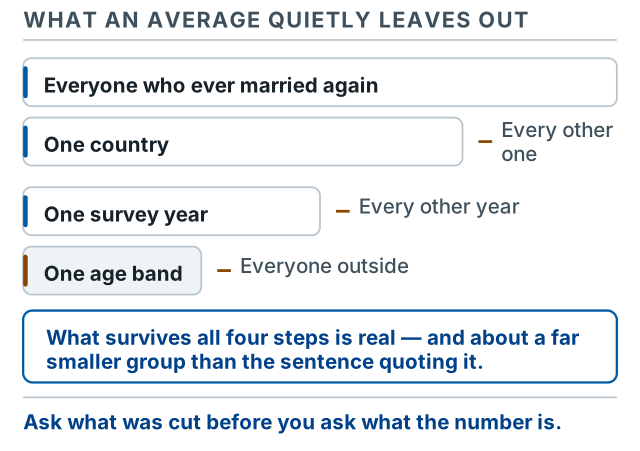
Because they are not timing the same interval. Before any figure is produced, someone has to decide when the stopwatch starts, when it stops, and who is inside the sample.
| The choice behind the figure | What it decides | Effect on the average |
|---|---|---|
| When the clock starts | Separation, filing date, or final decree | Couples often separate long before a decree, so a figure timed from separation runs much longer than one timed from the decree. |
| When the clock stops | The new wedding, or moving in with a new partner | Cohabiting before remarrying is common, so counting only the wedding hides part of the interval. |
| Who is counted | Everyone who divorced, or only those who did remarry | Averaging only remarriers removes everyone still unmarried, which shortens the result considerably. |
| Which country | Divorce law, waiting rules, registration | National systems differ enough that figures from two countries are not comparable, however similar the headline looks. |
| Which cohort | Marriages and divorces from which years | Figures describing divorces from decades ago are reprinted as if they described divorces finalised this year. |
Change any one row and the average moves. That is why two careful studies can publish different answers and both be defensible, and why the number lifted out of a study and put in a headline loses the thing that made it meaningful. The same problem sits under every figure in the second marriage divorce rate cluster.
How soon can you legally remarry?
Only after the divorce is final where it was granted — and in some places, not immediately even then. A waiting period is a gap that some systems place between the decree and a new marriage; some count from the date of the hearing rather than the paperwork, and some treat a foreign divorce differently from a domestic one.
That makes this a question with a local answer and no general one. Anyone planning a date should confirm it against their own decree rather than against an article, because a wedding booked before the divorce is effective creates a problem that is expensive to unwind.
What actually sets the timeline in practice?
Rarely a feeling. The people who describe their own gap between divorce and remarriage usually describe a queue of unfinished business, and the wedding waits at the back of it.
Property is the common bottleneck. A property settlement is the part of a divorce that decides who keeps or sells a home and who carries the debt on it, and a house that has not been sold or refinanced keeps two former spouses in a financial relationship long after the decree. Many couples prefer that resolved before a new marriage adds another set of claims, and couples often describe pension and insurance paperwork outlasting the divorce itself. Consider a couple who agree on everything except what happens to a jointly owned house: the wedding tends to wait behind the sale.
Children set a second timeline. Where a parenting arrangement is still being tested, families frequently say they did not want a wedding landing on top of it. The logistics of two homes are covered in more detail in the page on moving in together.
Money commitments set a third. Support obligations, debts assigned in the divorce, and whatever was promised to children from the first marriage all shape what a second marriage can reasonably take on, which is the practical reason estate and prenuptial questions come up early — the ground covered in prenups and inheritance.
Does a short gap mean anything about the marriage?
Not on its own, and the confident claims in both directions are unfounded. Aggregate patterns that link timing to outcomes cannot be applied to one household, and they carry all the definitional problems in the table above. Prediction research on marriages in general, such as the 2000 newlywed-stability study by Carrère and colleagues, was carried out on newlyweds rather than on remarrying couples, and it says nothing about the gap between a divorce and a new wedding.
What can be said without a statistic is narrower and more useful. A short gap is not a problem because it is short; it can become one when it means something else is unfinished — a property settlement still open, children who have not met the partner, or a decision driven by a lease ending rather than by the relationship.
A long gap is not a virtue for the same reason. Waiting does not resolve anything by itself. Couples who describe long gaps usually name something specific that was being resolved during them, not the passing of time.
The honest form of the question is not “how long is normal” but “what is still open, and does it need to close before a wedding.” That version can actually be answered by two people at a kitchen table.
What do people wish they had settled first?
Reported regrets cluster around paperwork rather than romance. Not because the emotional side is simple, but because the administrative side is the part that a fixed wedding date makes worse.
The recurring items are: an unresolved property settlement, wills and beneficiary nominations left pointing at a former spouse, unclear expectations about who pays for what, and an assumption that a stepparent will hold rights that do not arrive automatically with a marriage certificate. Each is easier to handle before a date is set than after.
None of this argues for delay as a principle. It argues for knowing which of these are open, so that the timeline is a decision rather than a discovery. The wider version of that checklist lives across the deciding hub.
What this page won't do
Timing questions attract confident advice, and most of it is either invented or unsafe to apply to a specific household.
- Name an average without a source
- No duration appears here unless the organisation that produced it can be named in the same sentence. Nothing currently meets that bar, so nothing is printed, and that is the honest state of the evidence rather than an omission.
- Repeat the one-year rule as fact
- The advice to wait a year before remarrying is folklore, not a finding. It may suit some households and not others, and it is repeated far more often than it is examined.
- Give a legal waiting period
- Waiting rules differ by jurisdiction and change. A page that names a period is guessing about a reader's location, and being wrong here can invalidate a wedding.
- Score readiness
- There is no quiz on this site that claims to tell a couple whether they have waited long enough. No instrument can do that, and one that says it can is entertainment.
Where this page stops
This page can set out why the averages disagree and which questions decide a legal date. It cannot say whether a particular couple has waited long enough, and it does not attempt to.
Where the sticking point is legal or financial — a settlement still open, support, pensions, the recognition of a decree — that is a family lawyer’s work, with an estate lawyer or a plan administrator for the parts that sit in their systems. Where children’s wellbeing is the question, a family therapist or a mediator is the right route, not an article.
If what brought someone to this page is grief that has not moved, or pressure from a partner to set a date, that belongs with a counsellor or therapist. If anyone is in immediate danger, that is a matter for emergency services or a helpline in their country.
The short version
The average time to remarry after divorce is a figure with too many definitions behind it to be quoted safely, and the honest answer is that the spread is wide and the sources disagree. Direction is sometimes visible; a usable number is not.
The legal question has a real answer, but it belongs to the jurisdiction that granted the divorce. The personal question has no external answer at all — only a list of open items, and the choice of whether to close them before or after a wedding.