
Do stepchildren inherit automatically?
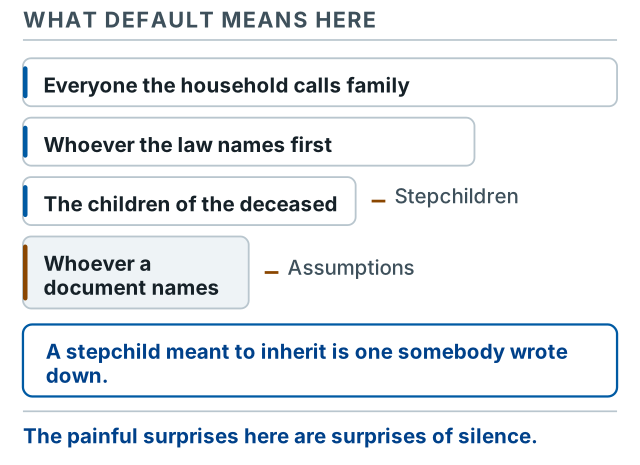
Almost never. Stepchildren and inheritance is a subject that runs on one default most people only discover at the worst possible time: legal systems tend to recognise a spouse and legally recognised children, and a stepchild sits outside both categories unless a legal adoption took place.
A stepchild is the child of somebody’s spouse from an earlier relationship, which is a description of a household rather than a category any form recognises on its own. Length of relationship does not change that. Imagine someone raised from a young age by a stepparent, who calls that person Dad, who was on the school forms and in the holiday photographs: they are in the same position as someone met in adulthood. Affection is not a category on a form.
The inverse also holds and is worth saying plainly: nothing here suggests that a stepchild should or should not inherit. Families decide that. The point is that the decision has to be written down, because the default decides otherwise.
What actually decides who inherits?
Not one document, which is the second surprise. Several separate instruments answer the question independently of each other, and they can contradict each other without anyone noticing for years.
A will speaks to what it covers. A trust, where one exists, speaks to what has been put inside it. A beneficiary designation is the instruction held by a provider or plan administrator naming who receives a policy or an account, filed with that provider rather than with a will, and designations of that kind on pensions, retirement accounts and life insurance policies generally answer on their own, regardless of what a will says. How a house or an account is titled — jointly, in one name, in some form of survivorship — can decide the largest single asset before any of the other documents are read.
There is a further layer that catches second marriages specifically, and it operates whatever the will says. A number of United States states give a surviving spouse a statutory claim on part of the estate regardless of its terms; New York’s right of election, written into that state’s Estates, Powers and Trusts Law, is one state’s version of it. It is quoted here as an illustration and nothing more. The size of the share, what counts as part of the estate, whether a prenuptial agreement can waive it and how long a surviving spouse has to claim all differ from state to state, differ again outside the United States, and change over time. What travels is only the shape of the thing: “I left everything to my children from my first marriage” is not self-executing anywhere, and an estate lawyer where you live is the person who says what applies to you.
That is why an estate lawyer asks about all of them, and why a page like this one cannot rule on any of them. The stack differs by country and by state, and the interaction between the layers is exactly where the disputes happen.
Where do the painful surprises come from?
Three situations come up repeatedly in what families report, and none of them involves anyone behaving badly.
The first is the mirror will: everything to the survivor, and after the survivor, to the children. It reads as fair on the day it is signed. What it relies on is that the survivor, years later, possibly remarried, leaves things exactly as agreed — and depending on how the documents were drafted, they may be entirely free not to.
The second is the beneficiary form nobody reopened. Pension and insurance paperwork filled in during a first marriage stays in force until someone actively changes it, so, for example, a policy taken out for a household that dissolved a decade ago is still holding the name it was given then. A will drafted after a divorce does not reliably reach it. Whether it does in your case is a question for the plan administrator and a lawyer, not for the internet.
The third is the house. It is usually the biggest asset and often the most emotionally loaded one: a home that stepchildren grew up in, or that a first marriage bought, now lived in by a second spouse who may need somewhere to live for the rest of their life. Two legitimate claims, one building.
How do families divide inheritance with stepchildren?
By choosing a principle first, then asking a professional whether the documents can deliver it.
The principles families name include equal shares to every child in the household regardless of biology; shares that follow whose assets they originally were; provision for the surviving spouse during their lifetime with what remains going to the children afterwards; and giving during life so that the outcome is visible rather than posthumous. Some families combine them, treating the house differently from everything else — for instance keeping it on one track and splitting savings on another.
This site describes those approaches because families describe them. It recommends none of them. What suits a household depends on facts nobody publishes: who owns what, who depends on whom, what was promised out loud, and what the law where you live actually permits.
Are your stepchildren still your stepchildren if your spouse dies?
Two answers, and they diverge. The relationship continues if the people in it want it to; plenty of stepparents and adult stepchildren stay close for decades after the marriage that connected them ended. Nothing legal is required for that.
The gap between those two answers has at least been measured as a matter of feeling. Pew Research Center’s portrait of stepfamilies, a telephone survey of United States adults fielded in 2010, found respondents reporting a real but weaker sense of obligation towards a stepparent or a stepchild than towards a parent or a grown biological child. That is what people said they would feel, in one country, more than a decade ago. It is not a legal duty, it does not predict what any particular family does, and it settles nothing about an estate.
The legal answer is narrower. A step-relationship that conferred no inheritance rights during the marriage will not usually start conferring them afterwards, and the same holds in the other direction: a stepparent is rarely an automatic heir of a stepchild. Where a widowed stepparent and their late spouse’s children are working out what happens next, the useful move is naming the question early rather than assuming shared understanding.
What should we ask, and who answers it?
The answerable version of this subject is a list of questions with a counterparty attached to each one. Bring these to the professional named beside them rather than to a search engine.
Should the children be told?
Families split on this, and both positions are held by reasonable people. Some tell adult children the outline of the plan while everyone can still ask questions; the argument is that a surprise read out after a funeral is the version most likely to end in a dispute. Others treat it as private until it takes effect.
There is no finding here that one is correct, and no readiness test on this site. Where the conversation involves minor children, or where it is likely to reopen something painful, a family therapist or a mediator is the person who handles it — not a lawyer, and not a website.
Where this page stops
At the jurisdiction line. No rule, threshold, deadline or amount appears above, and none should be read into it, because inheritance law differs between countries and between states and changes over time. What travels is the shape of the questions and the identity of the people who answer them: an estate lawyer, a family lawyer, the administrator of each plan or policy.
If the discussion is less about documents than about the relationships underneath them, that is a different professional again — a mediator or a family therapist. And if any part of this is landing on top of grief, distress or a situation that feels unsafe, contact a helpline in your country or a qualified practitioner before you contact anybody about paperwork.
Nearby on this site: the money and paperwork hub collects everything documentary in one place; estate planning in a second marriage covers the wider set of documents this page keeps referring to; a prenuptial agreement for inheritance is where the same conversation happens before the wedding rather than after; and step-parent rights covers the everyday version of the same gap between how a family feels and what a form recognises.