Why is a prenuptial agreement for inheritance usually about the children?
Because in a second marriage the person with most to lose is rarely the person signing. A prenuptial agreement for inheritance is a contract signed before a wedding that records what each partner brought in and what each intends to happen to it afterwards. In a second marriage it is generally drafted so that what one partner brought in reaches their own children, in the order and shape they intended, whatever happens to the marriage or to the parent.
That reframing matters, because the first marriage version of this conversation is about distrust between two adults. The second marriage version is mostly administrative: two people with existing obligations writing down which obligations survive the wedding.
Couples who describe the conversation going badly often describe starting it as a question about the relationship. Couples who describe it going quietly usually started it as a question about paperwork that already exists and already names somebody.
What do second-marriage couples usually put in one?
Four subjects come up again and again: property owned before the marriage, the home everyone will live in, what each estate leaves to which children, and debt.
Property from before. Anything with a history, such as a house, a business, savings built during another marriage, or an inheritance already received. The question is not only what it is but what happens to it if it is sold, mixed with joint money, or improved with joint money. Property that already moved once, in a divorce, has its own paper trail alongside the agreement: in the United States the federal tax side of that is set out in IRS Publication 504, for divorced or separated individuals, revised for each tax year, covering filing status, which parent claims a child, alimony after the 2018 change, and transfers of property incident to a divorce. Federal tax only — it says nothing about state tax, nothing about what an agreement may contain, and nothing about your own position. That half belongs to a tax professional.
The home. Frequently the hardest item, because two duties collide inside one building: a surviving spouse needs somewhere to live, and children from a first marriage often expect the house to reach them. Families describe several arrangements for that collision. None of them is recommended here, and each of them has jurisdictional consequences only a lawyer can state.
Each estate. An agreement can address what a spouse gives up or receives on death, and that sits directly against wills, trusts and beneficiary forms. This is where more than one professional is usually involved. Our page on estate planning in a second marriage treats that side as its own subject.
Debt. Less discussed and quite often the reason people start. What each person is carrying, what the other becomes exposed to, and what changes on the wedding day.
Can a prenup actually protect an inheritance?
Partly, and never on its own. An agreement is one document among several, and the others can contradict it without anybody noticing for years.
The recurring surprise in blended families is that a will and a beneficiary form are separate instruments. A beneficiary designation is the instruction held by the provider of a policy or account naming who receives it, filed with that provider rather than with a will. For example, a retirement account opened during a first marriage carries whichever name was written on its own form at the time, and an agreement signed this year does not go and edit it.
The second recurring surprise runs the other way: stepchildren are usually not heirs by default anywhere, which means an intention everybody in the household believes in can fail purely on documents. That is the whole subject of stepchildren and inheritance.
There is one place where a remarriage changes the federal picture directly rather than through anyone’s intentions. Since 2011 a surviving spouse in the United States has been able to elect to carry over a late spouse’s unused estate tax exclusion, on a timely filed return, which the IRS describes on its estate tax overview. How that election interacts with a subsequent marriage is not explained on that page, thresholds move whenever the legislation does, and several states levy their own estate or inheritance tax underneath the federal one. No figure appears here for exactly those reasons; an estate lawyer and a tax professional are the people who put a number on it.
So the honest version of the answer is that an agreement sets out intentions between two spouses, while wills, trusts, deeds and beneficiary forms are what actually move assets. An estate is the term for everything a person leaves behind to be dealt with after their death, and it reaches whoever those instruments say it reaches. Consistency between them is the work, and it is professional work.
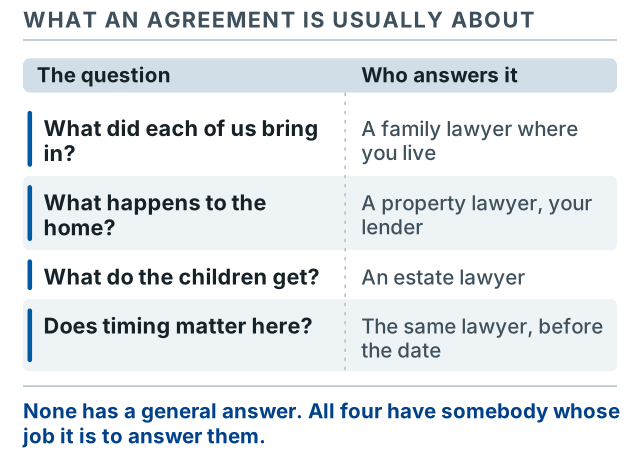
What should we ask, and who answers it?
Nothing on this page binds anybody. The useful part is knowing which question goes to which desk, and asking before a date is fixed rather than after.
What if there is not much money involved?
The conversation is often more useful when there is less, not more. Consider a household with one property and one pension: a single document naming the wrong person can move nearly everything the family has, and there is no spare margin to argue over afterwards.
What changes with a modest estate is scale, not structure. The same four subjects apply, the same forms decide what happens, and the same contradiction between a will and a beneficiary form produces the same result. If anything, families with less tend to have older paperwork, because nothing ever prompted a review of it.
Whether a formal agreement is proportionate at all is a fair question to put to a lawyer directly. Sometimes the answer is that updating wills and beneficiary forms carries most of the weight. That is a jurisdictional judgement, and it is theirs to make rather than ours.
Does any of this need to happen before the wedding day?
Some of it does, and that is why timing appears in several rows above. An agreement made in contemplation of marriage is normally signed before it, and rushing a signature close to the date is one of the things couples are often warned about.
The rest — wills, deeds, beneficiary forms — can be revisited afterwards, but marriage itself can alter what some of those documents do. Asking which of your papers are affected by the wedding, and in which order to fix them, is a single question with one counterparty: the lawyer handling the agreement.
How do people raise it without it becoming a verdict on the marriage?
Usually by making it early, boring and mutual. The couples who describe an ugly version of this conversation tend to describe it arriving late, from one side only, with a document already drafted.
A few habits get named repeatedly. Bring it up while the marriage is still hypothetical rather than scheduled. Have both people list what exists, not one. Independent advice means each partner taking their own lawyer’s counsel on the same draft rather than sharing one adviser, and it is normal here rather than a sign of distrust. Separate the legal appointment from the conversation at the kitchen table, so a solicitor’s wording is not doing emotional work it was never built for.
It also helps to say out loud who the document is for. “I want the flat to reach my son” is a sentence a partner can respond to. “My lawyer says we need this” is not.
If the disagreement is not really about assets but about whose children come first, a lawyer is the wrong professional. That belongs with a mediator or a family therapist, and it belongs there before it is written into a clause.
Are the numbers people quote about second marriages reliable?
Not as reliable as their confidence suggests. Figures for how often second marriages end, or how long they last, circulate widely with no source attached, and this site does not repeat them.
Where estimates exist at all, they disagree, because they measure different cohorts in different years using different definitions of what counts as a second marriage and what counts as an ending. A single true number does not exist to be quoted. Most of the ones passed around are folklore.
That matters here because the folklore does real work in this conversation: an agreement gets framed as betting against the marriage using a statistic nobody can source. The stronger reason to write things down has nothing to do with odds. Obligations to children from a first marriage exist whether the second marriage lasts a lifetime or not.
What this page will not do
It will not tell you what an agreement can contain where you live, whether yours would hold, what anything costs, or how long it takes. Those change by jurisdiction and over time, and a confident answer here would be wrong somewhere without the reader having any way to know.
It also will not tell any parent how to arrange another adult’s marriage. Questions about an adult child’s spouse are answered on the parent’s own side of the ledger, by an estate lawyer, and stop there.
Where this page stops
With a list of questions and a person for each one: a family lawyer in your jurisdiction for the agreement, an estate lawyer for what happens on death, each plan administrator or provider for the forms they hold, and the agency or court behind any existing payment. Each partner taking independent advice is normal here rather than adversarial.
If the sticking point is the household rather than the paperwork — how the children are told, whose home this is, who comes first — that is work for a family therapist or a mediator. If a conversation about money at home has stopped feeling safe, contact a helpline in your country before you contact a lawyer.
What comes with the role itself, as opposed to what a document gives you, is covered in step-parent rights. The rest of the paperwork sits in money and paperwork.