
Can you put stepchildren on health insurance?
Usually yes. Stepchildren on health insurance is the question of whether a plan will count a spouse’s child as a dependent, and of all the paperwork questions in a second marriage it is one of the few with a mostly encouraging answer: many employer and private plans treat a spouse’s child as an eligible dependent from the marriage onward, with no adoption and no custody order required.
The catch is where the answer comes from. A plan document is the contract between an employer or insurer and the person covered, and it is where the definition of a dependent lives — which means eligibility is set there and nowhere else. Plan documents are not identical. Two people working in the same industry can get opposite answers from their own benefits desks, and both answers are correct for the plan that gave them.
So the practical version of the question is not “can stepchildren be covered.” It is “does my plan define dependent in a way that includes this child, and what does it want from me.”
What decides whether a stepchild is eligible?
The definition of dependent in the plan document, and nothing else in the household.
Plans vary in what they attach to that definition. Some cover any stepchild of the covered employee once a marriage exists. Some add conditions, such as that the child lives in the home, that the covered person contributes to support, or that no other coverage is available. Age is almost always in there somewhere, and it is one more thing that differs by plan and by jurisdiction.
It is worth keeping two different tests apart while asking. Whether a child counts as a dependant under an employer’s health plan is decided by that plan’s own document. Whether a child counts as a dependent for United States federal tax is a separate matter, decided by a set of relationship, age, residency and support tests published in IRS Publication 501 and revised for each tax year. Passing one of those tests tells you nothing about the other, and neither of them makes anybody a legal parent.
None of that is discoverable from the outside, which is the honest limit of a page like this one. What it does mean is that the request should be specific. Not “do you cover stepchildren,” but “here is the situation — is this child eligible under this plan, and what will you need.”
What does the procedure usually look like?
A sequence, and the order matters more than most people expect.
The first step happens before the wedding, not after: ask each benefits administrator how their plan defines a dependent, and ask for the answer in writing. Two adults in a remarriage often have two plans between them, and comparing them is easier while nothing is urgent.
The second step is the window. An enrolment window is the limited period during which a plan will accept a change to who is covered, opened either on a fixed schedule or by a life event, and a marriage is commonly one of the events that opens one. That post-marriage window closes, and nobody sends a reminder about it during the week of a wedding, which is exactly when it tends to be running.
The third step is documents. Expect to prove the marriage and the child’s identity, possibly more. Ask for the list in advance so that the window is spent submitting paperwork rather than requesting it.
The fourth step is the part people skip: confirm that the enrolment actually took effect, and check the first statement or card that arrives. Administrative additions fail quietly.
What if the child is already covered by another parent’s plan?
Then the question changes from “can we add them” to “should we, and which plan pays first.”
A child can end up eligible under more than one plan — a biological parent’s, a stepparent’s, sometimes a public scheme. Coordination of benefits refers to the ordering rules insurers apply in that situation to decide which plan pays first and which one considers what is left. Consider a household where a child is on a biological parent’s policy and could also go on a stepparent’s: the ordering is settled by those rules rather than by whichever adult offers.
Two things follow. The plans need to be told about each other; concealing other coverage tends to surface later as a reimbursement problem. And the comparison worth doing is not about who is more generous in principle but about the specifics — which providers are in network, what the family actually uses, and what each option costs the household.
Where does a court order fit into this?
Sometimes squarely in the middle of it, and this is where a page stops being able to help.
Parenting arrangements and divorce settlements frequently say something about who carries health coverage for a child. Where such a provision exists, it can constrain what the adults involved are free to do — including a well-meant plan to move a child onto a stepparent’s better policy. It can also sit awkwardly beside a plan’s own eligibility rules.
This site names no rule, deadline or threshold on that, because those differ between countries and between states and change over time. What travels is the instruction: read the existing order before changing anything, and take the wording to a family lawyer if there is any doubt about what it requires. Adding a child in good faith and unpicking it afterwards is the expensive sequence.
Does adoption change any of this?
It changes the category the child is in, and therefore far more than insurance.
A stepchild covered under a plan is covered because of a marriage. An adopted child is legally the adopter’s child, and the connection no longer depends on the marriage continuing. That difference reaches inheritance, decision-making and the legal position of a birth parent — which is why adoption is never a sensible answer to a benefits question on its own.
Families who are already considering it for other reasons should ask a family lawyer what changes in every direction, not only the direction they were looking at.
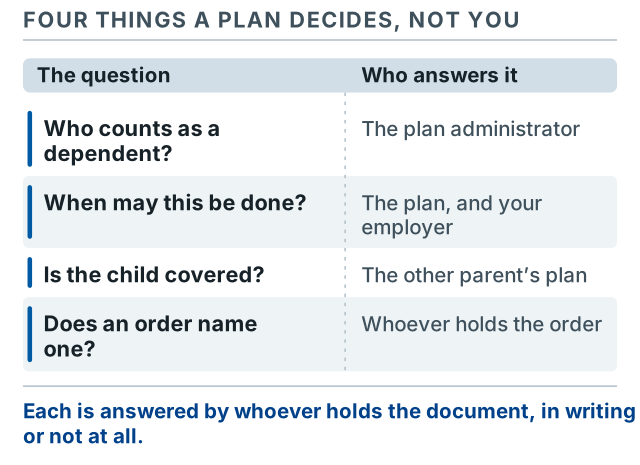
What should we ask, and who answers it?
Each row below is a question this page cannot answer, next to the person or institution that can. Working through them in order tends to take one afternoon and prevents most of the avoidable problems.
Who pays, and does that need saying out loud?
It usually does. Adding a stepchild to a plan often changes the premium, and in a household where each adult brought children from a previous relationship, the arithmetic gets noticed even when nobody mentions it.
Families describe different arrangements — one pooled household budget, contributions tracked by whose children generate which costs, or each parent carrying their own children where both plans allow it. This site recommends none of them. What is worth saying is that the arrangement should be explicit, because unspoken versions tend to be re-litigated during an argument about something else entirely.
Where the disagreement is really about fairness rather than about premiums, a mediator or a family therapist is better placed than any benefits desk.
Where this page stops
At the plan document and the jurisdiction line. No eligibility rule, age limit, deadline, waiting period or amount appears above, and none should be inferred, because these differ by country, by state and by insurer, and they change. What travels between situations is the shape of the questions and the identity of whoever answers them: a benefits administrator, a plan provider or insurer, a family lawyer, and — for anything written into an existing court order — a family lawyer with the order in front of them.
If the difficulty is less about forms than about a child’s wellbeing or a household that cannot agree, a family therapist or a mediator is the right professional. And if any part of this touches distress or a situation that feels unsafe, contact a helpline in your country or a qualified practitioner first; the paperwork will still be there afterwards.
Nearby on this site: the money and paperwork hub holds the rest of the documentary questions; stepchildren and inheritance covers the same gap between family and form in a harder place; step-parent rights explains why medical and school decisions can be a separate problem from paying for cover; and estate planning in a second marriage is where beneficiary forms, which behave much like enrolment forms, come back around.