
What does estate planning in a second marriage actually involve?
Estate planning in a second marriage is the work of writing down two answers that a first marriage rarely has to separate: what the surviving spouse ends up with, and what children from an earlier relationship end up with. Everything else on this subject — documents, structures, vocabulary — exists to serve those two answers.
The reason it is harder the second time is not sentiment. It is that a second marriage arrives with paperwork already in force, such as a will drafted for a household that no longer exists, a pension record filled in years ago, or a house with one name on the deed and two people living in it. None of that updates itself when a couple decides to marry.
Why does an old will stop working when you remarry?
Because it was written for a different family, and in many jurisdictions marriage itself changes what an existing will does. That is exactly the kind of rule that varies from place to place, so the useful move is not to learn the rule from an article — it is to assume the old document is out of date and have someone qualified confirm what it now says.
The same assumption applies to anything signed before this relationship: powers of attorney, healthcare directives, guardianship wishes for minor children. Documents from a first marriage often still name a former spouse. That is a discovery best made deliberately, on a weekday, with a professional in the room.
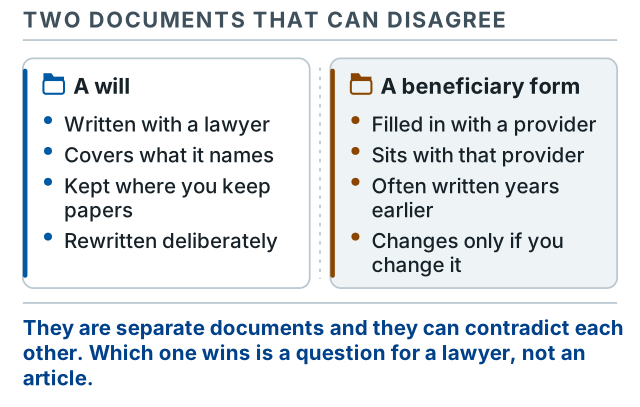
Which documents can outrank a will?
Several, and this is the part that surprises people. A beneficiary designation is the instruction held by a provider or plan administrator naming who receives a policy or an account, filed with that provider rather than with a will, and forms of that kind on pensions, retirement accounts, life insurance and some bank products are usually read on their own terms. The way a property is jointly owned can decide where it goes independently of any will.
Retirement money carries a further wrinkle worth naming before a second marriage. Under United States federal law, an interest in a private employer plan is generally moved to a spouse, former spouse or child only through a qualified domestic relations order, a mechanism the Department of Labor sets out in its guide to QDROs. The practical consequence is that a divorce decree on its own may not have moved anything. That guidance covers private employer plans under ERISA and nothing else — not individual retirement accounts, not government or military schemes, not Social Security — and it cannot tell anyone whether their own order qualifies. Whether an order from a previous divorce did what everyone assumed it did is a question for the plan administrator and a lawyer.
None of that makes a will pointless. It means a will is one instrument among several, and a plan that only updates the will can leave the largest single asset travelling to whoever was written on a form during a previous marriage. Whether that is true of a specific account is a question for the provider or plan administrator holding it — asked in writing, and confirmed in writing.
What is the tension that every blended-family plan has to resolve?
Provide fully for the surviving spouse, and children from an earlier marriage may receive nothing until that spouse also dies — by which time the estate has passed through someone else’s decisions. Provide directly for the children, and a surviving spouse may be left without the home or the income they expected. Most planning in a second marriage is a negotiated position between those two, and no arrangement makes the tension disappear.
Couples describe a range of approaches. Mirror wills are two wills written in matching terms, each partner leaving things to the other and then onward to an agreed list of people; other couples talk about structures that separate the right to live somewhere from ownership of it, about life insurance used to give one side its share without splitting a house, or about keeping certain property separate from the outset. This site reports that these come up in conversation. Whether any of them exists where you live, and whether it does what you assume it does, is precisely the question for an estate lawyer — not something to settle from a page written for everyone.
What should we find out, and who answers it?
What belongs to the couple rather than to a lawyer?
The decisions. A lawyer can set out which instruments exist and what each one does where you live. Nobody outside the marriage can decide what is fair between a spouse of a few years and children of a few decades — and that question is emotional long before it becomes technical.
Two conversations tend to matter more than any drafting session. The first: what each of you assumed would happen, said plainly, before either of you has picked up the vocabulary. Assumptions left unspoken get discovered at the worst possible moment. The second: whether adult children will be told what has been arranged. Some families tell them and take the argument now; others keep the documents private. Both happen, and both cost something.
If the money conversation keeps ending badly, that is not a legal problem and a lawyer is the wrong room for it. Mediators and family therapists work on exactly this.
What does a first pass look like in practice?
List what exists before deciding anything. Every account, policy, property and pension, with the name currently attached to it. Then list the people: spouse, each child, each stepchild, anyone with a prior court order attached to them.
Then decide who is being asked to carry it out. An executor is the person named to administer an estate after a death and to do what the documents say, which is an administrative job before it is an honour, and in a blended family it is also a position with a view of everyone’s business. How administrative it is can be read directly: for the United States federal tax half of the job, IRS Publication 559, for survivors, executors and administrators is revised each tax year and covers collecting assets, filing a final return and the basis of inherited property. It is a tax document and it decides nothing about who inherits — that is state law, and it is the estate lawyer’s half.
Take both lists to one appointment rather than researching structures beforehand. Couples who arrive with an inventory and a plain sentence about what they want tend to get further in an hour than couples who arrive with terminology. Then set a date to revisit it. Documents drift out of date quietly, for instance after a birth, a death, a house move, or a change in anyone’s health.
Where this page stops
This page names questions and counterparties. It does not state what the law requires, allows or prohibits anywhere, because that differs across borders and changes over time, and a reader has no way of knowing which version they have been handed. Anything binding comes from an estate or family lawyer who knows your jurisdiction, or from the administrator of the specific plan or policy involved.
If these conversations are surfacing conflict inside the household rather than paperwork problems, a family therapist or mediator is the appropriate professional. If anyone in the household is at risk, or the pressure involves control over money and documents, contact a helpline in your country — that is outside what any article can handle.
Related on this site: the wider money and paperwork hub, the question of what stepchildren inherit by default, how a prenuptial agreement is used to protect an inheritance, and what step-parent rights do and do not cover.