
What actually has to be decided before two households merge?
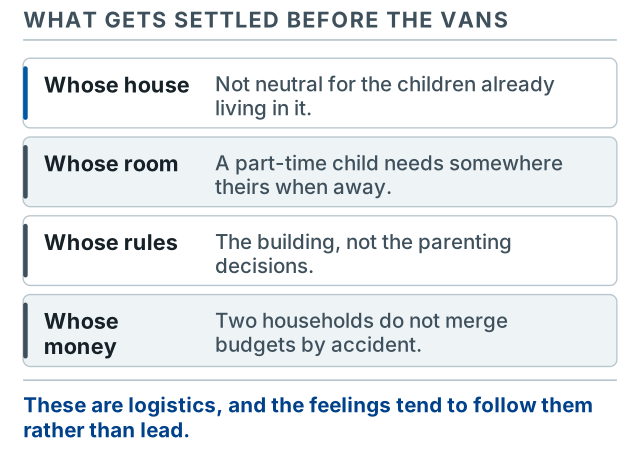
Four things, and they are all practical: space, rules, money, and time with each parent’s own children. A blended family moving in together is, at this stage, a logistics problem rather than a relationship one — two sets of habits, two sets of possessions and two schedules arriving at a single address. Everything harder than that — how people feel about each other, what the children call whom — moves on its own schedule and cannot be arranged in advance. The four logistics can be, and the households that settle them early spend less of year one arguing about them.
The reason this list is short is that most first-year friction traces back to one of the four. A row about shoes in the hallway is usually a row about whose house this is. A row about a Saturday is usually a row about time that used to belong to one parent and one child.
Whose house should everyone live in?
Whichever one nobody has to lose too much to enter — and where a third house was affordable, families who took that route describe it as worth the cost. Moving into a home that already has a history is a common arrangement, and one that often produces the phrase “this isn’t my house.”
What families report weighing: which home is nearer to the schools already in use, which one has enough rooms for children who visit as well as children who live there, whose mortgage or lease can actually be ended, and whether one house is still visibly the previous family’s house. Photographs, furniture and a kitchen arranged by someone else all carry more weight than people expect.
If a third house is out of reach, the workaround households describe is redistribution rather than relocation: the incoming adult and children get rooms that were not previously assigned, and something visible in the shared space changes so that the home is not a museum of the household that was there first.
How do bedrooms work when some children are only there part of the week?
A part-time child still needs a full-time place to put things. That is the single point families come back to: a room shared or a bed in a study is workable; having nowhere that stays theirs while they are at their other parent’s home is what children describe as being a guest.
Arrangements households name include: a room kept as theirs even when empty, a shared room with a drawer, shelf and wall that are not touched, or a rotating arrangement where two children swap rooms according to the schedule. The variable that matters is not square metres but permanence — whether their things stay put.
Doors, locks and knocking are worth agreeing in the first week. Teenagers moving into a house with younger step-siblings, in particular, tend to raise privacy before they raise anything else.
Which household rules merge, and which are left alone?
Most families merge the rules that govern shared space and leave the parenting rules where they were. House rules are the merged set — screens at the table, noise after a certain hour, who cleans what — and they apply to everyone under the roof. Parenting decisions are the other set: bedtimes, homework, phones and consequences, which tend to stay with each child’s own parent, at least at the start.
The distinction matters because it separates two arguments that get confused. “The dishwasher gets emptied by whoever is nearest” is a household agreement. “Your son should not have a phone at fourteen” is a parenting decision about someone else’s child, and this site does not rule on those.
Discipline is the sharpest version of that split and deserves its own conversation before the move rather than during the first bad week. Approaches families use differ widely, and we set them out separately in what a stepparent’s role with discipline looks like.
Two practical habits get named often: writing the house rules down where everyone can see them, and reviewing them once the schedule has been tested for a few weeks rather than defending the first draft.
How do couples handle money in the first year, when the children are not shared?
Separately at first, in most accounts, with a shared pot for the house. The complication in a blended household is that income often arrives with obligations already attached — payments in, payments out, costs for a child that only one adult is responsible for — and a single joint account makes those invisible. Consider a month in which one adult pays for a school trip for their own child while the couple splits the electricity: two costs of quite different kinds, indistinguishable once they leave the same account.
One of those obligations is worth understanding structurally before the arithmetic starts. In the United States, child support amounts are not set nationally: the federal regulation on child support guidelines requires each state to establish its own guidelines and to review them at least every four years. That regulation states no amount and says nothing about how a remarriage or a new partner’s income is treated — those are questions for the guidelines in your own state and for a family lawyer. What it does establish is that “the rule depends where you live” is literally how the system was built.
Some of this is a conversation between two adults. Some of it is not, and the second kind has a counterparty who should be asked directly.
Between the two adults, the questions are plainer: which costs are shared because they are the house, which stay with each parent because they belong to a specific child, and what happens when the two are genuinely unequal. Households that write this down once tend to revisit it after a few months rather than carry a running grievance.
The vocabulary for that conversation is not specific to stepfamilies at all. Nedra Glover Tawwab’s Set Boundaries, Find Peace is a general book about boundaries between adults — it was not written about blended households, it says nothing about children, and it has no bearing on any of the questions above that belong to a lawyer or a provider. What it offers a couple is a way of saying what is shared and what is not without it landing as an accusation.
How does a parent keep time with their own children after the move?
By scheduling it, awkward as that sounds. A loss children often name after a move is not the new people in the house — it is the disappearance of ordinary time alone with their own parent, which used to happen without planning and now competes with a full household.
What families do: a standing weekly slot per child, or protecting an existing ritual such as the drive to a practice or a Sunday breakfast, precisely because it predates the new household and is theirs. The content matters less than the fact that it is unshared and predictable.
The mirror problem is the couple, who now have a house full of people and no evenings. Both kinds of time have to be defended against the schedule; neither survives on goodwill.
What do families say is hardest about the first year?
The gap between how long the adults expected it to take and how long it takes. The couple has usually had months or years to arrive at this decision. For the children the move can be the first concrete consequence of it, and they start from a different place.
Other things named often: the schedule belonging to someone outside the house, the absence of privacy in the early weeks, an adult who feels like staff rather than a parent, and the discovery that two reasonable sets of household habits can be completely incompatible.
None of this is a verdict on whether the household will work. It is the standard content of a first year, and it is why this hub treats the move as logistics rather than as a milestone. More of the practical patterns are collected in our blended family tips, and the legal limits of a stepparent’s position are set out under step-parent rights.
Where this page stops
This page covers logistics. It does not assess children, and it does not tell any adult how to raise someone else’s child.
Where the difficulty is about a child’s wellbeing rather than about rooms and rotas, the right next step is a family therapist or, for disagreements about schedules and arrangements, a mediator. Where money, property or a payment is involved, the questions above go to a family lawyer, an estate lawyer, or the provider that holds the plan. If anyone in the household is unsafe or in crisis, contact a helpline in your country or local emergency services rather than reading further.
The rest of this hub is at The blended family.