
Which blended family tips are actually usable?
Blended family tips are usable when an adult can act on them without instructing anyone else’s child, and that narrows the list fast. Agreeing who handles which child before the first difficult evening, keeping house logistics separate from parenting decisions, writing down the money and the calendar, and defending unshared time between each parent and their own children — those four are inside the couple’s control.
Most published advice fails on that test. It tells a stepparent how a child should behave, or tells a parent how their ex should co-operate. Neither is something the reader can execute on a Tuesday. This page stays on the side of the line where action is possible.
What should the two adults settle between themselves first?
Who has authority over which child, stated plainly, before it is tested. A conflict families name often is not a child’s behaviour but two adults discovering mid-argument that they never agreed who was allowed to respond to it.
Arrangements households name include: each parent handles their own children entirely at the start; both adults enforce the house rules but only the biological parent handles consequences; or a gradual handover as the relationship establishes itself. This site does not recommend one. It matters far more that the couple has picked one on a calm afternoon than which one they picked, and the full range is set out in what a stepparent’s role with discipline looks like.
The second thing to settle is what happens when one adult disagrees with the other in front of the children. A habit households describe as useful is simple sequencing: the parent’s decision stands in the moment, the disagreement happens later without an audience.
How do house rules differ from parenting decisions?
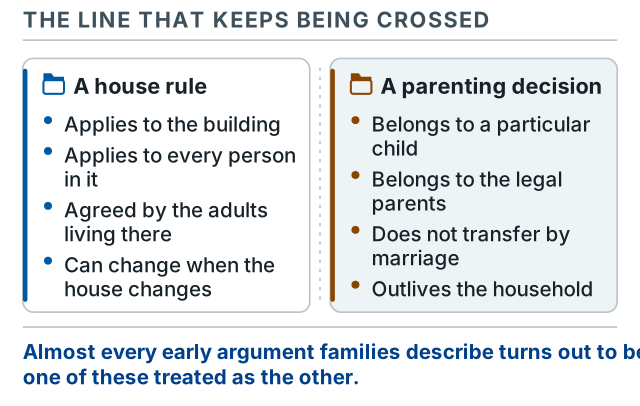
House rules are the ones that govern shared space, and they apply to everyone under the roof. Parenting decisions are the ones that belong to each child’s own parent. Confusing the two is what turns a dispute about the dishwasher into a dispute about someone’s competence as a father.
Shared-space rules families write down, such as noise after a certain hour, phones at the table, who cleans what, knocking on closed doors, and what is borrowed and what is not, are the ones everyone can renegotiate. That includes the children, because everyone in the house is subject to them.
Parenting decisions include bedtimes, screen limits, homework, allowance and consequences. When those differ between the two children’s sets, households mostly report leaving them different rather than forcing a merge.
A practical marker: if the rule would apply to a visiting adult friend, it is a house rule. If it only makes sense applied to a specific child, it is that child’s parent’s call.
What is worth writing down?
Three things, because all three get remembered differently under stress: the money split, the calendar, and the house rules. Writing them down is not bureaucracy; it removes the argument about what was agreed and leaves only the argument about whether it still works.
Money in a blended household rarely divides cleanly, because income often arrives with obligations already attached to a specific child. Households commonly separate costs that belong to the house from costs that belong to one parent and one child, and revisit the split once rather than carrying a running grievance. The practical version of that conversation sits in the first-year logistics of moving in together.
The calendar is worth writing down because a blended household usually runs on a schedule it does not fully control. A handover is the point in the week when a child moves between households, and it is usually set by an arrangement the couple had no part in; an ex’s plans, school terms in two districts and a court order can all outrank the couple’s Saturday in the same way. Seeing the whole thing in one place is what stops each collision from feeling like a fresh betrayal.
Some money and paperwork questions do not have an answer that two adults can agree between themselves at all.
How much time should each parent spend alone with their own children?
Enough that it survives the household schedule, which in practice means it has to be booked. The loss children name after two families combine is usually not the arrival of new people. It is the quiet disappearance of ordinary unshared time with their own parent, which used to happen without planning and now competes with a full house.
What families describe protecting: a standing weekly slot per child, or an existing ritual that predates the new household, such as a drive to a practice or a Saturday breakfast. The activity matters less than the fact that it is unshared, predictable, and not cancelled first when the week gets busy.
The mirror problem belongs to the couple, who now live in a full house and have no evenings. Both kinds of time need defending against the same calendar, and neither survives on goodwill alone. The literature on protecting a couple’s own time is general rather than stepfamily-specific — Stan Tatkin’s Wired for Love treats two adults as a unit and was not written about blended households or about children in them — so take it for what it is: material about the pair, with nothing in it that applies to anyone else in the house.
What do stepparents find hardest, and what helps?
The mismatch between responsibility and standing. A stepparent is often doing the work of a parent — driving, cooking, paying, being present — inside a role that carries no assumed authority and, in most jurisdictions, no default legal status either.
What people in the role describe as useful: taking the long view on the relationship with the children rather than working to a timetable; being clear with the partner about what the role does and does not include; and letting the children set the pace of naming and closeness, which is covered separately in what stepchildren call a stepparent.
The nearest thing to a published finding here points the same way, and narrowly. Ganong and colleagues’ 2019 study in the Journal of Family Psychology examined stepfathers’ affinity-seeking — the deliberate work of building the relationship — and reported it as associated with better stepfather–stepchild relationship quality and greater stepfamily cohesion. It studied stepfathers, with mothers also reporting, so it says nothing about stepmothers; the association is not a demonstration of cause; and it contains no method for anyone to copy. It is cited because it traces to a named journal, named authors and a year, which is more than most advice on this subject manages.
What people in the role often describe as unhelpful: trying to replace a parent who exists, competing with the other household, or treating a child’s coolness as a verdict on the marriage. None of that is a diagnosis of any child; it is what adults in the role report about their own worst weeks.
What about the numbers people quote about blended families?
Treat almost all of them as folklore until a source is named in the same sentence. Numbered parenting rules, success percentages and “it takes X years” timelines circulate widely and are rarely traceable to anything.
The one broad claim with genuine support is qualitative: second marriages end in divorce more often than first marriages, by various estimates. There is no single agreed figure, and the published ones differ because they count different cohorts, different years and different definitions of a marriage ending. Our page on what the second marriage divorce rate actually says sets out why the numbers disagree.
This matters practically, not just editorially. A household that believes it is running behind an imaginary schedule tends to force closeness that was arriving anyway.
Where this page stops
This page describes what adults can arrange between themselves. It does not assess children, and it does not tell any adult how to raise someone else’s child.
Where the difficulty concerns a child’s wellbeing rather than rooms, rules and rotas, a family therapist is the right next step, and a mediator where the disagreement is about schedules or arrangements between households. Legal and financial questions go to a family lawyer, an estate lawyer, or the body that holds the payment or the plan. If anyone in the household is unsafe or in crisis, contact a helpline in your country or local emergency services rather than reading further.
The rest of this hub is at The blended family.