
What are the actual pros and cons of a blended family?
Blended family pros and cons are mostly the same facts read from two directions. More adults in the house means more hands and more income, and also more opinions about bedtime. A wider family means children with more people who care about them, and more houses to be driven between at Christmas. Lists that put these in separate columns make the household sound like a choice between two options it is not.
That is why this page is arranged as both sides of each item rather than as a verdict. Nobody weighs these the same way, and the weighting shifts with the ages of the children, how much time each child spends in the house, and how the previous households ended.
Why does the same feature appear as both a pro and a con?
Because the thing that adds a resource usually adds a claim on it at the same time. An extra adult is capacity and also a second authority. A part-time child is one whose weeks are split between two homes, which is a quieter house for the couple and a household that reconfigures itself twice a month. The advantage and the cost are the same structural fact.
| What is in the house | Named as a gain | Named as a cost |
|---|---|---|
| A second adult | More income, more driving, someone else who notices | A second set of standards about someone else's child |
| Children on both sides | Built-in company; nobody is the only new arrival | Two rule sets, two histories, comparisons in both directions |
| A part-time child | Quieter weeks; time for the couple exists at all | The household changes shape on a schedule it did not set |
| A wider family network | More adults invested in each child | More holidays to divide, more opinions on the marriage |
| Adults who have been married before | Fewer illusions; both know what ended a marriage | Habits, caution, and comparisons that arrive with them |
The practical use of that table is in disagreements. Consider two adults arguing about whether the new arrangement is working: they are often looking at the same feature from opposite rows, and the argument is about weighting rather than about facts.
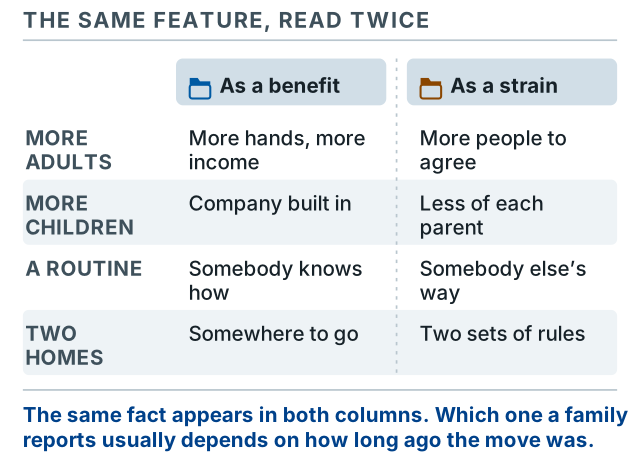
What do families name as the benefits of blended families?
Four things come up repeatedly, and none of them is the sentiment usually printed on this subject.
Redundancy is the one named first and most plainly. A single-parent household has one adult for every school run, every illness and every emergency, and a second adult in the house is capacity that did not exist before.
A child gets more adults who are on their side. Not a replacement parent — an extra adult who turns up, remembers, and pays attention. Children often describe this in specific terms long before they describe it in affectionate ones.
Both adults have already lost something. People entering a second household usually know what a marriage ending looks like from the inside. Households describe this as an unglamorous kind of realism: fewer assumptions that things will simply hold together, more willingness to raise a problem while it is still small.
Siblings, when it works. Not guaranteed and not on a schedule. Where step-siblings do form a bond, adults describe it as the part they had the least control over and value the most.
What do families name as the hardest parts?
Roles without a script, rules that clash, money with obligations attached, and a calendar that belongs partly to someone who does not live in the house.
The role problem is the one adults raise most. A stepparent is often expected to behave like a parent while holding neither the authority nor the standing of one, and the gap between those two positions is where most of the first-year frustration sits. Approaches families use range from strict separation to fully shared rules; we set them out without ranking them in what a stepparent’s role with discipline looks like.
The rules problem is smaller than it feels and worth separating carefully. Shared-space rules apply to everyone in the house. Parenting decisions about a specific child usually stay with that child’s own parent, at least at the start. Confusing the two turns a dishwasher argument into a custody argument.
Money is the one that is quiet longest. Income in a blended household often arrives with obligations already attached, and costs are rarely symmetrical between the two sides. The logistics of that first year — space, rules, bills, one-to-one time — are covered separately in moving in together.
The calendar is the item people underestimate. Holidays, handovers and school events are often fixed by an arrangement made before this household existed, and no amount of goodwill inside the house changes them.
Which parts are not a matter of opinion?
The legal and financial ones. How a household feels about stepchildren has no bearing on whether the law treats them as family for inheritance, medical decisions or benefits, and the answers differ by jurisdiction and change over time. That half is not a pro or a con to be weighed; it is a set of questions with owners, such as an estate lawyer, a family lawyer or the body that administers a plan.
Answering these before the wedding is administrative rather than romantic, and it removes a category of argument that otherwise reappears for years.
Do the pros and cons change over time?
The composition changes even when the household does not. The logistical complaints of the first year — rooms, routines, who empties what — tend to lose intensity once the arrangement has been tested, while the relationship questions run on their own clock and do not respond to scheduling.
Children’s ages shift the weighting. For example, a young child who lives in the house full-time and a teenager who arrives every other weekend are in different situations under the same roof, and an arrangement that suits one can be the exact thing the other resents.
Some things do not shift at all. A schedule set by a court order or by another parent stays external. A previous relationship that ended badly keeps generating logistics. Households describe learning to plan around those rather than expecting them to resolve.
Is there a statistic that settles whether blended families work?
No, and pages that offer one rarely name where it came from. Estimates of how second marriages and stepfamily households fare do circulate widely, and the figures disagree because the studies behind them use different cohorts, different years, and different definitions of what counts as a blended family or a second marriage.
This site does not print a number it cannot attribute in the same sentence as its source. It is also worth noticing what the traceable counts actually measure. A brief such as NCFMR’s profile of stepfamilies among cohabiting and married women under 45 counts household composition in a defined population, using the United States National Survey of Family Growth: how many of those unions included a partner’s child, and how that moved between 1988 and 2017. That is a question about who lives with whom. It is not a verdict on whether any of those households work, and no sourced count on this subject is.
What can be said qualitatively is that separation is generally reported as more common in second marriages than in first ones, with estimates varying by source, and that no single figure represents every household. Why the numbers conflict is set out in more detail under the second marriage divorce rate.
The more useful point for a household deciding anything: an aggregate rate describes a population, not a specific couple with a specific set of children, schedules and finances.
Where this page stops
This page describes what households report. It does not assess anyone’s family, it does not diagnose a child’s behaviour, and it does not tell an adult how to raise someone else’s child.
Where the difficulty concerns a child’s wellbeing, a family therapist is the right route, and for disputes about schedules and arrangements between households, a mediator. Where money, property, inheritance or benefits are involved, the questions above go to a family lawyer, an estate lawyer, or the body that administers the payment or plan. If anyone in the household is unsafe or in crisis, contact a helpline in your country or your local emergency services rather than reading further.
The rest of this hub is at The blended family.