
What is a successful second marriage?
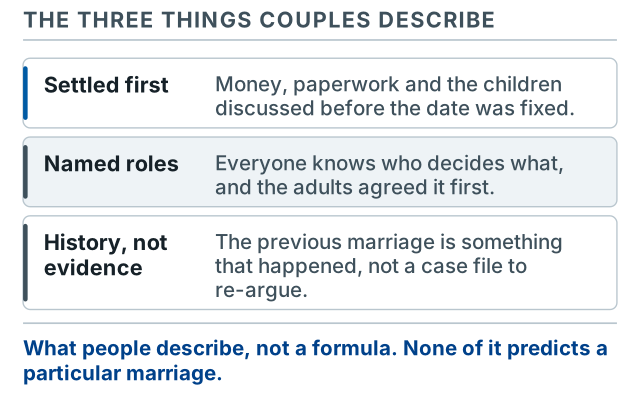
A successful second marriage is, in the accounts of people who describe theirs that way, one where the practical arrangements were settled out loud before the wedding rather than discovered afterwards. Money, housing, the children’s routines, and what each adult is responsible for.
That is a duller answer than the one most pages give, and it is the one that keeps appearing. Couples rarely credit chemistry or timing. They credit having said the awkward things early, usually because the previous marriage taught them what happens when nobody does.
Nothing on this page predicts an outcome. There is no scored test here, and any site offering one is selling entertainment. What follows is a description of what people name, which is a different and more honest thing than a formula.
What do couples actually name when they say it works?
Four themes recur across the accounts, and all four are arrangements rather than feelings. They are the parts of a remarriage after divorce that a first marriage generally did not have to negotiate at the start.
| The area | What was settled | What it looks like when it wasn't |
|---|---|---|
| Money | Whose income covers what, what stays separate, what happens to each person's assets | Discovering an obligation to a previous household after the wedding, or a partner's debt nobody mentioned |
| Housing | Whose home, whose name is on it, and what happens to a house one partner already owned | One family moving into another family's territory, with the children's bedrooms as the flashpoint |
| Roles with children | What each adult does and does not handle, agreed between the adults first | A stepparent enforcing rules they were never given the standing to enforce |
| The other household | A workable method for scheduling, messaging and disagreements with an ex-spouse | Every exchange becoming a fresh negotiation, with the couple arguing about the ex instead of the schedule |
None of these is a personality question. Each is a decision two adults can sit down and make, and each becomes considerably harder to make once a wedding has already happened.
What makes second marriages work differently from first ones?
The difference is that a second marriage starts with commitments already in place. A first marriage usually begins with two people whose obligations to each other outrank almost everything else. A remarriage rarely does.
Income may already be committed elsewhere. A house may already be someone’s. Children have a schedule set by an order or an arrangement, and that schedule does not rearrange itself for a new partner. The other household refers to a former spouse’s home and the arrangements running between the two addresses, and it remains part of the logistics whatever anyone feels about it.
Consider a household where one partner’s children are there midweek and the other’s at weekends: the calendar exists before either adult has decided anything about it.
Couples who describe their remarriage as working tend to treat those facts as conditions rather than problems. The ones who describe strain more often expected the new marriage to override them. That is the pattern people report; it is not a rule, and it does not sort anyone into a category.
The practical version of all this is the first year of a combined household, which has its own logistics and its own predictable arguments. Those are set out in moving in together as a blended family.
Does the divorce statistic say anything about one couple?
Not about any particular couple, no. Aggregate figures are descriptions of the behaviour of a large group over a period, and they make no statement about a specific household inside one.
There is also no single agreed figure. Published estimates come from different countries, different survey years and different definitions of a marriage ending, which is why honest sources disagree. The consistent finding is direction rather than size: remarriages end somewhat more often than first marriages, by various estimates. Where those estimates come from and why they conflict is set out on second marriage divorce rate.
Two things follow. Treating a population figure as a personal forecast is a category error. And the widely repeated percentages about second marriages behave like folklore: quoted everywhere, sourced nowhere, rounded slightly differently each time.
Prediction research on marriages in general is a separate body of work, and Gottman and Levenson’s 1992 study of marital dissolution is its usual reference point. It was carried out on marriages in general rather than on remarriages, and it supports no claim about the share of endings that any set of behaviours accounts for.
What this page won't do
The remarriage advice category has some well-worn habits that are worth naming, because most readers arriving here have already met them.
- Score your readiness
- Quizzes promising to tell a couple whether their marriage will hold are not measuring anything. There is no instrument here, and a page that offers one is usually funnelling readers towards a purchase.
- Promise an outcome for a behaviour
- Sentences of the form 'second marriages last if you...' are unsupportable. This page describes what couples name, and naming something is not the same as proving it caused anything.
- Coach anyone on managing an ex-spouse
- Advice that treats a former partner as an obstacle to be worked around usually makes the children's arrangements worse. Where conflict is real, a mediator is the route, not a technique from an article.
- Tell you how to raise another person's child
- The role of a stepparent is agreed between the adults involved and the child's other parent. No website has enough information about a household to issue instructions about its children.
What should be sorted out before the wedding, and with whom?
Most of what couples later wish they had settled is either legal or financial, which means it is not a conversation two people can finish alone. Law differs by jurisdiction and changes, and nothing on this site is legal or financial advice. What can be listed is which questions belong to which professional.
The legal and financial half of a remarriage is set out across the money and paperwork hub, and a question that comes up often before a second wedding is covered in prenuptial agreements and inheritance.
What do people say they got wrong the first time round?
The recurring account is not about choosing badly. It is about subjects that were never opened, such as what money meant to each of them, how conflict would be handled, and what each expected of the other in a household that already had children in it. How conflict runs is the part with research behind it, and the popular form of that work is the Gottman Institute’s description of the four horsemen. It describes marriages in general rather than remarriages.
Second-time couples often describe going the other way and over-explaining. Long conversations about who pays for what, written notes on schedules, saying out loud that the stepparent will not be the one issuing consequences in the first year. A stepparent is a role the adults define between themselves and with the child’s other parent, and nothing about it arrives automatically with a marriage certificate. It looks unromantic from the outside. Inside, people describe it as the thing that made the household calm.
That is a description of what couples report, not a prescription. Two households with identical arrangements can end up in different places, and nobody writing a page like this one knows which is which.
Where this page stops
This page can describe what couples name. It cannot assess a particular relationship, and no article can.
If the real question is whether a specific marriage should go ahead, that is work for a couples counsellor or a family therapist, ideally one who works with remarriage and stepfamilies. Where children are struggling with the arrangement, a family therapist or a mediator is the route rather than a website. Where money, property or a will is the sticking point, that is a family lawyer and an estate lawyer.
If anyone is frightened of their partner rather than uncertain about them, or is in immediate danger, that is a matter for a helpline in their country or for emergency services. A page about what makes second marriages work is not the right place for that question.
The short version
A successful second marriage is described by the people in it as an arranged one: money, housing, roles with children and the other household all settled before the wedding rather than after. The reported difference from a first marriage is that commitments already exist and do not rearrange themselves.
No figure on this site predicts an outcome for one couple, and no test here claims to. Readers weighing the decision itself will find the rest of the questions collected in the deciding hub.