
Does remarriage affect Social Security?
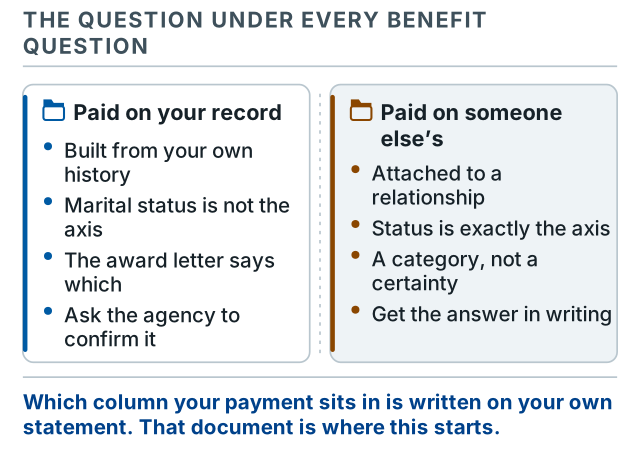
It can, and the honest short version is short. Social security remarriage questions are all versions of one question: whose work record your money comes from. Payments earned on your own record are generally about your own history. Payments made because of someone else — a current spouse, a former spouse, a spouse who died — are attached to a marital status, and marriage changes that status.
That is the whole shape of the issue. Everything else is detail that belongs to a benefit type, an age, a date and a country, and those four things are exactly what a general article cannot know about you.
Which benefits are people actually asking about?
Usually one of four. Benefits on your own earnings record. Spousal benefits claimed on a husband’s or wife’s record. Benefits claimed on a former spouse’s record after a divorce. And survivor benefits: a survivor benefit is a payment made on the record of a spouse who has died rather than on the record of the person receiving it. A new marriage does not touch all four the same way, and mixing them up is a well-known reason people arrive at the agency with the wrong worry. For the survivor category the United States publishes its conditions as regulation text — 20 CFR 404.335, on widow’s and widower’s benefits, is where the structure of that one lives, including the ages at which remarriage stops mattering. Reading it shows the shape of the rule. It is not your record, it covers no other country, and regulations get amended. Imagine two neighbours comparing notes over a fence, one on her own record and one on a late husband’s; they are not discussing the same thing at all.
There is a fifth category worth naming: benefits paid for children, including in some systems children of a deceased parent. Those follow the child, not the adults’ marital status, but the household’s paperwork can change when a step-parent enters it. Ask about the children’s payments separately rather than assuming they travel with yours.
Why won’t this page tell you what happens to your payment?
Because the rules are national, they are conditional, and they move. The United States runs Social Security through the Social Security Administration; other countries run their own contributory pension and survivor systems with different names and different conditions. Two readers with identical family histories in different countries get different answers.
Within a single system, the answer still depends on ages, on how long each marriage lasted, on whether a claim has already started, and on which record the payment sits against. Any page that states a threshold as though it settles the matter is guessing on your behalf, and the cost of that guess falls entirely on you.
There is a second reason. Thresholds get amended. A sentence written confidently some years ago is still online, still confident, and possibly wrong now. You cannot tell by looking, and neither can we.
Where does the real answer come from?
From the agency that pays the benefit, applied to your actual records, in writing. In the United States that is the Social Security Administration, at ssa.gov, or a scheduled appointment at a local office. Elsewhere it is the equivalent national body. This page is a route to that desk, not a substitute for it.
If you would rather read the United States conditions than a summary of them, they are public. The regulation on benefits as a divorced spouse is the one behind most questions about claiming on a former spouse’s record, and it sets out conditions rather than amounts. It is a different benefit from the survivor rules above, with different consequences on remarriage, which is exactly the confusion this section is trying to prevent. Neither page computes anything for anybody; the agency does that, on your records.
Two practical points about that conversation. First, take documents rather than a summary of them, such as marriage and divorce certificates, a death certificate where relevant, dates, and your award letters. An award letter is the notice an agency sends setting out what it has decided to pay and on what basis, which is why it is the first thing worth digging out. Second, ask for the answer in a form you can keep. A phone call that goes well is not evidence six months later when a payment changes.
What should we find out, and who answers it?
What tends to go wrong
Three patterns, none of them exotic. Assuming a rule heard from a relative applies to a different benefit than the one they had. Booking a wedding first and asking afterwards. Checking the state system carefully and forgetting the private one. A workplace pension is a scheme run by an employer or a provider, with its own documents, its own forms and its own definitions of spouse, survivor and beneficiary, none of which are inherited from the state system.
The fix in all three cases is the same and it is unglamorous: list every payment either of you receives or expects, then find out who administers each one, then ask each administrator the same question about marriage. It is an afternoon of phone calls and an hour of filing.
Where this page stops
This page names questions and counterparties. It does not state what any benefit system requires, allows or pays anywhere, and it deliberately quotes no thresholds, ages or amounts, because those differ by country and change over time. Anything binding comes from the agency that administers your benefit, from the administrator of a private scheme, or from a lawyer who knows your jurisdiction.
If a benefit change makes the marriage itself feel financially risky, that is a decision for the two of you with real figures in front of you — a financial adviser or a mediator is the right room, not an article. If anyone in the household is being pressured over money, documents or a claim, contact a helpline in your country.
Related on this site: the money and paperwork hub, what estate planning in a second marriage has to settle, whether stepchildren inherit by default, and what step-parent rights actually cover.